Followers

Tuesday, December 27, 2011

The Spirit of Generosity

    This Christmas will go down in my personal history book as “the best ever.” Not because of the gifts, or the way-too-abundant holiday treats, or the decorations. Not because of the Christmas concerts and other celebrations, or the cards and letters reminding us that we’re important to the far-flung people we love.

    What made it “best ever” was the spirit of generosity that touched us in many ways.

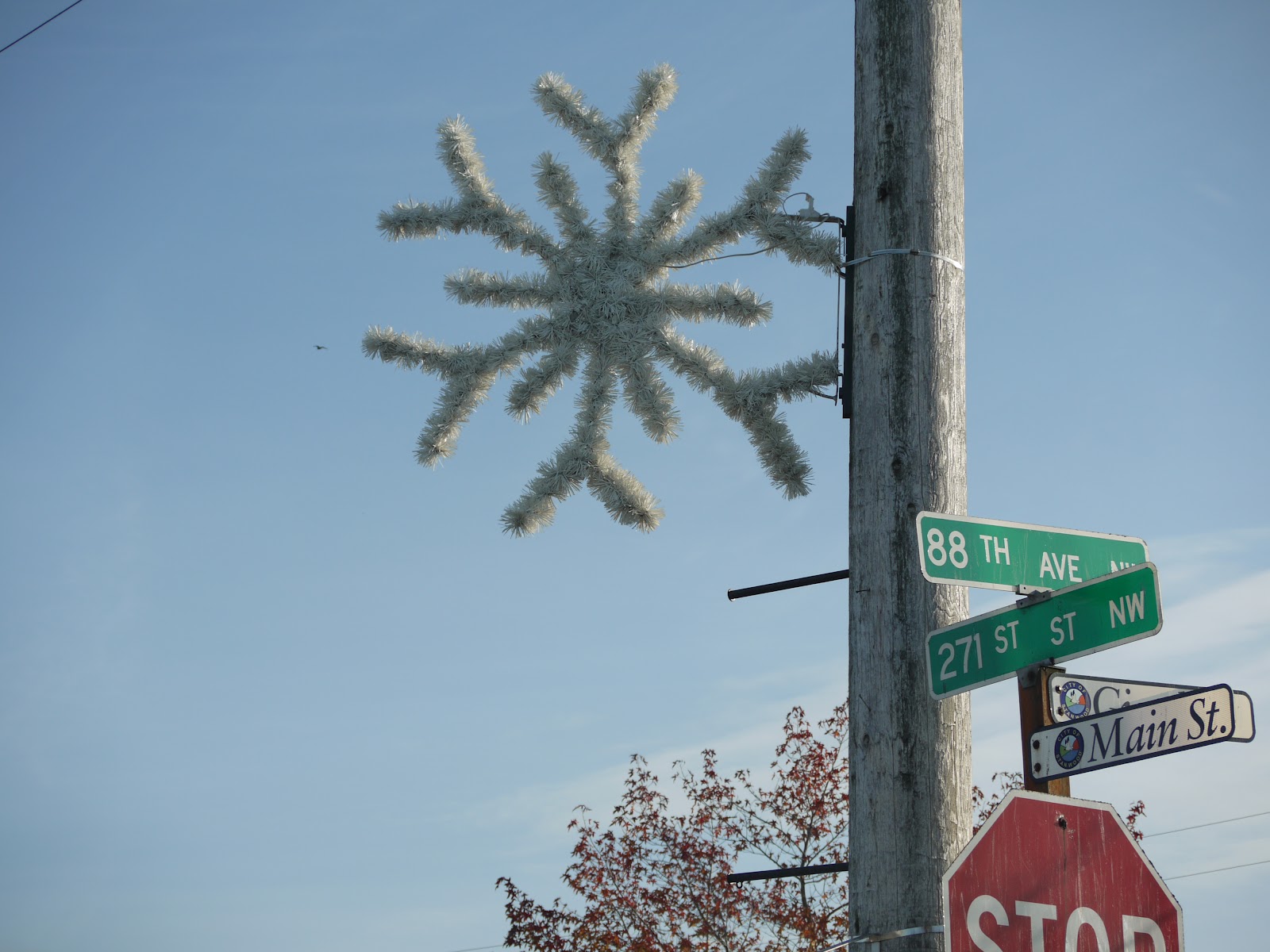
    Every year, somebody hangs giant snowflakes and lighted wreaths along our town’s main street. While out walking the morning after Thanksgiving, we caught them in the act. Stanwood Lions Club volunteers were partnering with a TV cable company to put up snowflakes that sparkled in the fog. The man in charge told us the Lions also hoist the lighted Christmas tree to the top of Stanwood’s icon, the old Hamilton Lumber Mill smokestack, as well as install other symbols for later holidays.

    Another day, we joined a number of senior citizens at Stanwood’s Community and Senior Center for Christmas luncheon. We were all delighted when one hundred fifty children from nearby Cedarhome Elementary School filed in to entertain us with a varied and enthusiastic program of holiday music, some of it original compositions from their teacher, Mr. Rich Crouch. Thanks kids and teacher, for sharing your talent!
Dennis Bunch on his Honda 1300cc

    When we drove to Camano Island to finish our Christmas shopping, we were amused to see Santa Claus sitting by the highway, waving from a bright red Honda motorcycle. We stopped to talk with him and take his picture. Santa (Dennis Bunch) has been sitting on that motorcycle for several hours a day, every Christmas season for six years, because he feels its a way he can bless others.

    Volunteers around Stanwood come by ones, by a few, or by the hundreds. The Warm Beach Lights of Christmas, only four miles from town, is known all over the country for its more than one million lights and its family-friendly activities that go on for twenty nights in December. More than 800 volunteers band together to set up the displays, man the events, and later take it all down again. They make this a happy, well-loved destination for young and old.

    For us, what made this Christmas truly “the best ever” was a generous gesture from one of our sons. His sister lives in the Arizona desert. She’s homesick for the damp green Pacific Northwest at Christmas time and we miss her, too. His gift to all of us was to fly her home for a weekend packed with love and fun.

    What better way to celebrate the birth of One who gave the best gift ever than to imitate his giving spirit? That spirit of generosity is the thread that ties the whole package together.

Tuesday, November 29, 2011

John Aaron Rawlins, a Man for His Time


Brigadier General John A. Rawlins, Chief of Staff,
at City Point, VA, with wife and child at door of their quarters


Before the American Revolution, three brothers named Rawlins came to settle in the colonies from England. At Sun Breaks, http//rainsongpress.blogspot.com,  the entry for August 28, 2011 begins a three-part story about one of them, ancestor James Mason Rawlins, who was willing to give up his family and perhaps his life for what he thought was right.

James Mason Rawlins was born around 1737. Soon after, in 1742, another Rawlins boy named James entered the world. He was James Rawlins III, born to Sarah and James Rawlins II. James Rawlins III became the great-grandfather of John Aaron Rawlins, the subject of this story. By 1826, both John’s family and descendants of James Mason Rawlins were living in Illinois.

Despite a crash course in beginning genealogy, I haven’t yet discovered how or if John Aaron Rawlins is related to our branch of the Rawlins family. But since one purpose in telling these tales is to show how our family (and all American families) help make up the larger history of these United States, here is the story of Major General John Aaron Rawlins. 


    John Aaron Rawlins was born in Galena, Illinois on February 13, 1831, one of eight siblings in a family of very modest means. He helped to support the family by hauling the charcoal made by his father to nearby towns and selling it. When his father left to join the 1849 California gold rush, John looked after his mother and siblings. He loved his father deeply but hated his bad habits. Because of his father’s drinking, John vowed never to touch strong drink. One writer thinks it was this aversion, as much as anything else, that became the basis for his place in history.

    John was an intelligent, darkly handsome young man with an unusual gift for oratory. His early education was spotty, but at the age of twenty he entered secondary school with the goal of becoming an attorney. He was admitted to the Illinois bar in 1855 and practiced law in his hometown. By 1858 he’d become interested in politics. Though a staunch Democrat, according to writer Lee Bonnet, he made speeches on behalf of fellow Illinois resident, Republican Abraham Lincoln, in the 1860 presidential campaign.¹

    Then the Civil War broke out. After the first Battle of Bull Run as the fighting moved closer to home, Rawlins organized a band of civilians into the 45th Illinois Volunteers, inspiring the new soldiers with his rousing speeches.

    The town of Galena was intensely loyal to the Northern cause. More generals called Galena home than any other Union city. The town probably contributed more privates, as well. One night local Republicans staged a big political meeting. Rawlins was advised that they would not welcome him as a Democrat, but he insisted he was going, and if asked to speak, he would not remain silent. Wherever he went, he was usually asked to speak, and it happened again that night.

    One of those attending the meeting was a modest, rather inarticulate colonel named Ulysses S. Grant. He had been a clerk in his father’s leather-goods store and knew Rawlins slightly because Rawlins had done legal work for the company.

    When the audience called “Rawlins! Rawlins!” John responded. He made what one author called “one of the great speeches of the Civil War period: a speech which rallied everyone, regardless of party, regardless of previous views about slavery and about sectionalism, regardless of anything and everything. He appealed to the God of battles to aid the great cause of the North; he appealed to everyone to give his utmost.”²

    Grant was among those who wanted to give his utmost. He asked Rawlins to join him as assistant in his military ventures, and as Grant advanced up the ranks to general, so did Rawlins. Eventually Grant made him his chief of staff.
   
    One of John Aaron Rawlins’ outstanding characteristics was his loyalty. He’d been fiercely faithful to his wife, Emily, with whom he had three children, and remained at her side, comforting her until her death in August 1861 of tuberculosis, a major killer of that day. Though in deep sorrow, he joined Grant to become one of his most trusted confidantes, deeply involved in every decision and every battle. He organized Grant’s military camp and also worked to protect Grant from the demon of strong drink.
   
    According to historian Elmer Gortz, Rawlins did have an interesting flaw or ability, depending upon one’s perspective. When the occasion warranted, he could erupt into the most passionate, evocative, eloquent surge of swearing imaginable. One of the people who witnessed his colorful language was a northern girl named Emma Hurlbut.

     Emma was working in Vicksburg, Mississippi, as a governess during the siege of the city. Rawlins was assigned to protect her from the unwanted attentions of soldiers and officers. Not only did he do his job well, he also courted and married her. Emma was able to curb his profanity.

    John Rawlins had become a Major General by the time the war ended in 1865. He returned to his law practice in Galena. By then, he’d also contracted tuberculosis.

    In the summer of 1867, General Grant urged his chief of staff to go out West, hoping that the climate might help him recover. Accompanied by an aide and several friends, Rawlins traveled to Cheyenne, Wyoming. There he met General Grenville M. Dodge and a party of civil engineers who were surveying a railroad route westward from Omaha.
   
    As the company rode west on their horses, approaching the hills near the present city of Rawlins, Wyoming, the ailing general expressed a desire for a drink of good, cold water. Scouts set out to explore. They discovered a fine spring of water near the base of the hills and brought some back to the sick man. General Rawlins declared he’d never tasted a drink more refreshing. “If anything is ever named after me, I hope it will be a spring of water,” he said. General Dodge heard what he said and immediately named it “Rawlins Spring.”

    The town that grew up near the spring, a division point of the railroad, was at first called “Rawlins Spring.” Later, the name was shortened to “Rawlins.”

    Unfortunately, the expedition did not improve Rawlins’ health. He returned to the East, and a short time later Ulysses S. Grant became President Grant. The president summoned his old friend Rawlins to Washington, D.C., and in March 1869, made him secretary of war.

    John Aaron Rawlins died five months later at the age of thirty eight, on September 6, 1869. He is buried in Arlington National Cemetery.


¹ http://www.imrubicon.com/general.htm (Lee Bonnet)

² from Three Galena Generals, by Elmer Gortz, 1955 (Speech to Illinois Historical Society)

Tuesday, November 8, 2011

Giving the Gift of Heritage

GIVING THE GIFT OF HERITAGE

    Sharing Your Stories
   
    Guest Blogger, Sharon Brilla

Something in our hearts responds to story. Before the invention of radio and TV, before we even had access to the written word, stories were the way we passed on our history and our culture. We especially love tales of courage and triumph over difficult circumstances. Stories about family help us know where we fit in the scheme of things. What small child doesn’t beg, “Tell me a story?”
   
Sharon Brilla, Co-Director of Social Services at Josephine Sunset Home here in Stanwood, says:
“One of the greatest gifts we can give to our families is sharing our trials and failures and how we overcame in the midst of turmoil.” She relates this to the Biblical account of Moses leading the Israelites out of their Egyptian captivity to the land God had promised them. Moses told the people, “‘Teach what you’ve seen and heard to your children and grandchildren.’ As we face tough economic times we can help the current generation learn to face adversity and remind them we can be over comers.

“My mother told about putting cardboard in her shoes because she couldn’t afford another pair of shoes. All of us have Exodus stories about how our family has survived when life happens. Our challenge is to share our stories with the next generation and teach them to recognize their own stories.

Christmas time is a perfect opportunity to remind our families of our triumphs and lessons learned from the hard times. This year give the gift of legacy and start a new family tradition.”
   
Here are some of Sharon’s ideas:

* Start a journal with stories from the past and add new stories throughout the year

* Play a game of remembering past victories. ‘I remember the time Grandpa’s car broke down on the  freeway and….’


* Start a prayer journal with your family. Record answers to your prayers.


* Share a time when you failed and what you learned from the failure.

* Encourage younger family members to share their Exodus stories. This year I will remind my grandson of his fears on the first day of school. That morning he asked me to pray, and when school was out, he said, ‘I had a good day, Grandma.’


Here are a few ideas from Sun Breaks:

* When you put your photos in albums, or download them to your computer, be sure to label them with the occasion, place, and people in them. Don’t let your treasured photos end up in a shoe box in some estate sale because no one knows their significance.

* Keep a journal, if only jottings on a calendar to keep track of important daily happenings.

* Keep scrapbooks of family events.

Wednesday, October 26, 2011

The Snow Geese are Back!

     Recently, a morning fog mass crept across Skagit Bay and the farms on the delta below us. For a few moments the bank’s leading edge paused at the northern reach of Port Susan and the mouth of the Stillaguamish River. We watched the fog swallow the farms along the shore and blot out Camano Island. Soon it swirled into the treetops on our hillside.

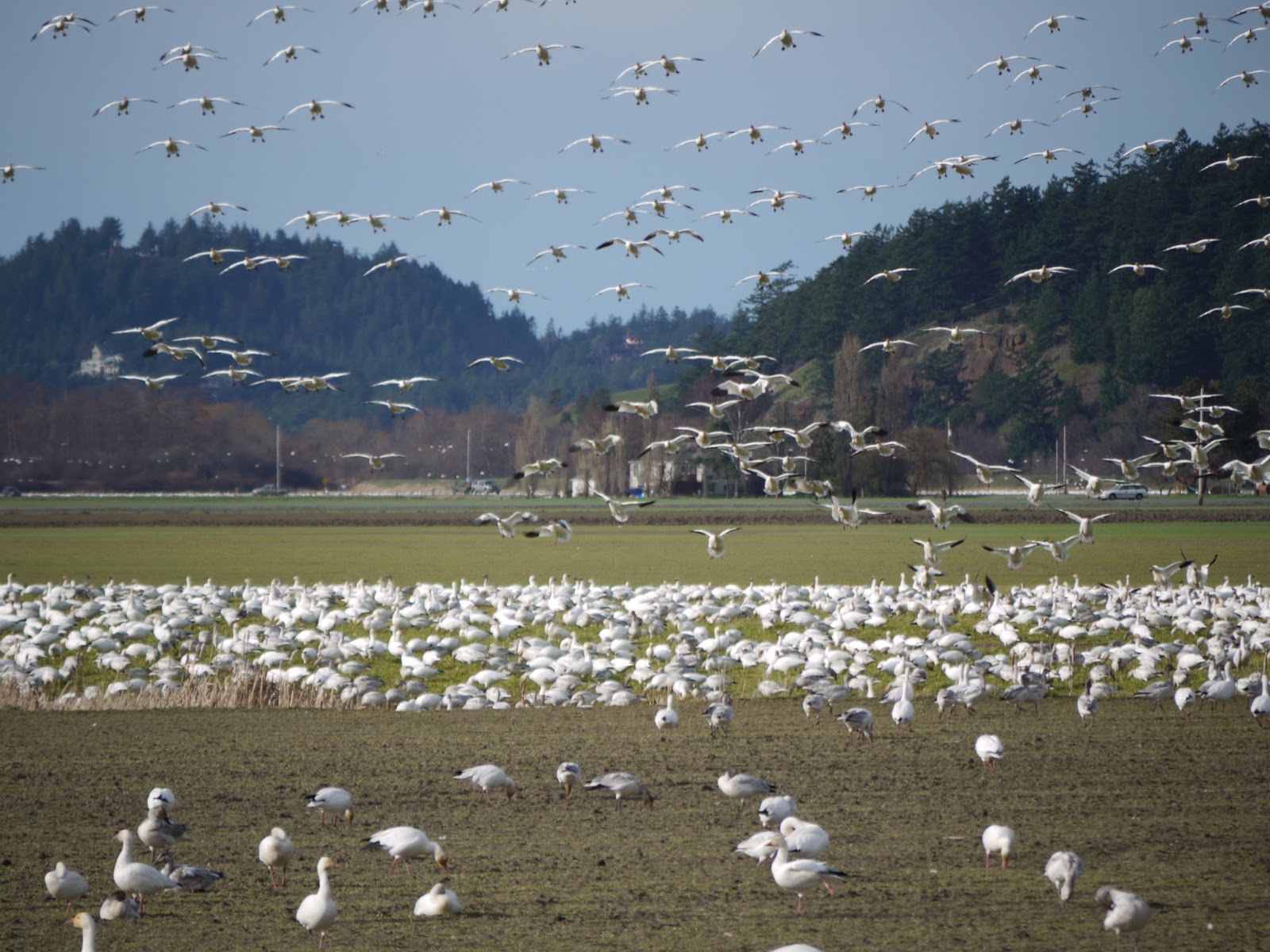
    When we stepped outside, we heard disembodied voices gabbling in the fog. The Lesser Snow Geese were back!
  
    Later, we drove to the Rexville store on Fir Island, one of our favorite places for lunch, passing a large flock of snow geese grazing in a field. While we waited for our order, Rexville’s proprietor told us he’d recently talked with a Russian ornithologist who studies the birds at their nesting grounds on Wrangell Island, not the Wrangell Island in Alaska’s panhandle, but the Russian island in the Arctic Ocean north of Siberia. He passed on some interesting facts he’d learned from the visiting scientist.
 
The orange faces show this family group has been feeding in the iron-rich soil of the salt marshes.


    Some of the Wrangell Island geese winter in California. The rest winter locally and would show up soon. The Lesser Snow Geese we’d seen, the proprietor informed us, would not stay. They would feed and rest for a while, then fly on. 

    Snow geese usually mate for life and can live from 10 to 20 years in the wild. They raise three or four young every year. During the summer, they molt and can’t fly. The Russian expert described how most of the geese prefer the tundra at one end of the island for their nesting sites, though quite a few nest at the other end. When the goslings get strong enough, the whole of the smaller group (thousands of parents and young) set out walking to join the geese at the other end of the island, at least 40 miles away, even struggling across a rugged mountain range. On the way, many lose their lives to Arctic foxes and other predators but the flock keeps going.

    The snow geese who winter here in the deltas of the Stillaguamish and Skagit Rivers are part of the Fraser-Skagit population, and move back and forth between the estuaries of the Skagit and Fraser Rivers. A sanctuary has been established in the center of the Fraser estuary for the compact white birds with the black wing tips and pink bills and feet.  About half of the wintering geese can be seen swirling over the farm fields and intertidal marshes of the sanctuary from mid-October to mid-December, and again from mid-March to mid-April. The other half fly on to the Skagit Delta, where they will be joined by the rest of the flock from mid-December to mid-March.

    In January, 2010, the two flocks totaled 75,500 birds. Researchers estimated that forty percent that year were young birds, identified by their grayer plumage. The following January, there were only about 65,000 birds with very few young. The nesting season in Siberia had been poor.

    Snow geese feed on the intertidal marsh plants of the estuaries, such as bulrush and sedges, using their strong bills to dig up roots and rhizomes. Visitors will notice the head feathers of geese who have been uprooting marsh plants have been stained orange by the iron-rich soil.

    In the fall, farmers plant grass cover, not only for soil enrichment, but for the geese and other wildlife. The geese will also eat any unharvested crops, including leftover potatoes in the field. One of the Northwest’s most spectacular sights is a large, dense flock of snow geese marching across level farm fields in close formation, feeding as they go. If a bald eagle (or dog, or person) comes too close, the geese will take flight, then swirl down in another location like a storm of noisy snowflakes.

    Scientists working on Wrangell Island have banded some birds with colored neck collars and fitted others with radio transmitters to aid in population and migration studies. If you come to watch our winter visitors and notice any marked birds, you can assist the ongoing international research projects by reporting your observations to The British Columbia Waterfowl Society, 5191 Robertson Road, Delta, BC V4K 3N2. Phone: 604-946-6980
   

Friday, September 23, 2011

Making a Memorable Reunion


Mary and Connie find their husbands in an early reunion photo
Did your family, like ours, have a reunion this summer? It’s not too soon to begin planning your next one—no matter when you want to schedule it.

About sixteen years ago, when my dad and his youngest sister Mary were the only siblings still alive out of the original seven, we began a tradition of getting together every other August. Our reunions not only allow family members of all ages to connect with each other in a deeper way, but we also feel more connected to previous generations.

Here are some of the fun ideas we’ve used to help draw us closer. Feel free to adapt them for your next family get-together.


~Genealogy Chart
 Cousin Jackie’s an expert genealogist who has unearthed fascinating stories about the family. She contributed a beautiful genealogy chart (above) showing ancestors from Thomas and Ethel Rawlins, the parents of the seven siblings mentioned above, all the way back to the 1700s. The chart is featured at every reunion.

~Family Trees
Some of us see each other only at reunions. We use Sister Patty’s family “Tree” to help us place people in the proper families and learn their names. Photos of Thomas and Ethel are at the base of the tree. Twigs on separate branches for each of their seven children feature pictures of the siblings’ children’s and grandchildren.

~Reunion Albums
Cousin Bill, a photographer, made a 2-by-3-foot blow-up of a photo from the first Rawlins  reunion. All the cousins, in their sixties and seventies now, were crowded together on the grass in a laughing group. Today’s children like to pick out their grandparents in the black-and-white photo.

(All three of the above ideas can be seen in the above photo.)

Today everyone has a digital camera, so we take lots of pictures. We keep an album chronicling each reunion. It’s fun to leaf through the pages, watching the changes as the children grow up and revisiting memories of loved ones no longer with us.

~T-shirts
At one reunion, someone brought several plain t-shirts and some fine-point permanent markers. We signed our names on each shirt, as decorative or simple as we wished. Later, names were drawn to choose the shirts’ lucky recipients. Another time, everyone wore matching t-shirts screen printed with “Rawlins Reunion” across a silhouette of a tree.

~Video recordings
Video recordings of previous reunions are fun to watch and become increasingly precious as the years pass. One of the most enjoyable featured Aunt Mary, one of the seven siblings, sharing memories of her North Dakota childhood and the early years of the family in Washington.

Everyone, young to old, has fun at the Rawlins Reunion


~Games
Different volunteers at each reunion supervise games for kids and grownups. Home-grown fun is best...like this wrap-the-mummy contest, using toilet paper and cooperative volunteers like Delaney.

~Picture Match
This year we had a contest to see who could match the most graduation photos with the present-day versions of the same people. Most kids were able to pick out their own parents and grandparents, and everyone had fun seeing how we’ve changed.

Listening to William's story
~Tell Me a Story
When our great-great-great grandfather Thomas Main Redfield, a blacksmith, was alive, he wrote long poems telling stories of his family and his travels. William Shaw, his many-times-removed great grandson, turned one of those poems about two children being rescued from a runaway horse and carriage into a dramatic reading. His sister Clarissa Austin expanded another family story about Grandmother Ethel and a prairie fire into a narrative that had us all wondering what would happen next.


~Interviews
Young family members were given a list of questions to use in interviewing older members. Then each interviewer introduced his or her partner and shared the fun and surprising facts they’d uncovered.

~Timelines
Eugene and Vicki look over the timeline
In a timeline game, Cousin Vickie handed out strips of paper: yellow for Grandfather Thomas’s side of the family, green for Grandmother Ethel’s, and blue for their descendants. Names and dates were printed on each strip. All those with a strip of paper gathered at the front where we could all see them, and at a signal, they hurried to arrange themselves by color and date. Then each person put his or her family member(s) in the proper place on a vertical timeline. By this time names were becoming familiar and the timeline helped us see the continuity of the generations.

~Sing-Alongs
Everyone knows "Twinkle, Twinkle, Little Star"
We brought one of our most enjoyable family reunions to a close with an old-fashioned sing-along. We’d planned to use old-time favorites such as “Bicycle Built for Two” and “Cruisin’ Down the River on a Sunday Afternoon. We found that not even the oldsters knew all the words, so next time we’ll make song booklets so everybody can join in. Meanwhile, we improvised with a mixture of children’s tunes and campfire songs.

Friday, September 9, 2011

James Mason Rawlings: Loyalist or Traitor?

(This is Part 3 of a 3-part story. For the rest of the story, read the blogposts for Aug. 28 and 30.)

    With the discovery of their plot against the Revolution’s local leaders, the conspirators, including James Rawlings, fled. He must have kept in contact with his family, because about a month later a man named Abram Jones heard that “a certain James Rawlings was one of the heads amongst the Tories and that he was expected to pass by the settlement of Mattamuskeet, or to call there about the next day.”

  Lake Mattamuskeet is in Hyde County, on the coast of North Carolina. At that time, it was open to the sea, although now it is a self-contained lake. Jones kept watch for Rawlings. When he spied a small sail off in the sound, he took four men with him and set off after the boat. He found Rawlings and his family in the boat, heading out to sea where they hoped to meet up with an English vessel. One of the children, George, was only three or four years of age. Jones captured Rawlings and carried him before a magistrate, who took the deposition quoted earlier.

    In a follow-up letter from James Rawlings to the “Worshipful Justices of New Bern,” he gave more details about his co-conspirator Lewellen’s schemes. He also said, “Knowing the great influence Capt. Lewelling has over that neighborhood (I) have great reason to fear he will make attempts to invalidate my testimony.” Rawlings stated that he’d refused to kill anyone and “that I, being a poor man, have reason to fear his (Lewelling’s) power and influence over others to my hurt, as all the friends or power I have is to declare the Truth and Humbly Crave pardon for having had any hand in said plot or Scheme, testifying whatever shall come to my Memory I will make known about the matter.”

    Evidently he had reason to fear Lewelling’s influence. He was jailed...for a while. The next mention of him is a wanted notice from Craven County, North Carolina. It appeared October 24, 1777, in the Virginia Gazette, an early newspaper in Colonial Virginia, along with wanted notices for two other men.

The notice reads as follows:

 James Mason Rawlings for high treason, he is a noted villain, and one of the principals in the late conspiracy against the state, has lived for 2 years past in Martin County, and is a very famous in the art of Legerdemaen, about 40 years of age, of a very black complexion and had a cut on one of his cheeks, given under seal 9 Sep. 1777.

    A reward of ten pounds was offered for Rawlings, 5 pounds for each of the other two.

    The notice indicates that James Rawlings had escaped his confinement and that he was considered important enough to appear in a Virginia newspaper. At the time of the notice James had lived in Martin County for about two years, 1776 and 1777. He had a dark complexion and a scar (or maybe a wound?) on one of his cheeks. The word legerdemain means sleight-of-hand trickery of any sort. This implies that he was very clever and hard to catch.
Rawlins descendants learning about their history, August 2011

    One researcher discovered that between September 11, 1777 and November, 1777, Rawlings had signed up to sail from New Bern with Captain William Pile but did not report. Pile testified on November 22 that a Colonel White from Georgia had promised Rawlings a better situation and the last Pile had heard, Rawlings was “on the way to South Carolina in the company of Colonel White’s wagons.”

    Whatever happened, James Mason Rawlings dropped from sight. One branch of family tradition holds that he was recaptured and executed. Other family members believed he escaped to England, where he lived out his life.

    After James Mason Rawlings disappeared, Priscilla and their children remained on the North Carolina frontier. His brothers and his own family dropped the "g" from Rawlings, perhaps to avoid being associated with his disgrace. In 1782, Priscilla Rawlins and her daughter Nancy are shown on the membership role for Sandy Run Baptist Church in Rutherford County, North Carolina.   

    Records of the early Mormon Church show that their grandson James, an early Mormon convert, had a baptism-for-the-dead ceremony done for James Mason and Priscilla. Since this James was aware that his grandfather was dead, he must have had some knowledge of his death and therefore, the tradition of James Mason Rawlings deserting his family and never being heard from again doesn't seem to ring true.

    The family must have loved and had fond memories of their grandfather, since many of his descendants carried his name. One of his children, Charles, became our direct ancestor. His descendants followed the frontier westward, preaching, farming, blacksmithing, teaching, and helping to build America.

    More about some of them later!

Tuesday, August 30, 2011

James Mason Rawlins: Traitor or Not? Part 2

    (This is Part 2 of a 3-Part story. For the beginning of the story, read the blogpost for Aug. 28, 2011)

    Our first Rawlins ancestor in the New World, James Mason Rawlings, was a Loyalist who in 1777 found himself accused of high treason and conspiracy against the state of North Carolina. From the clues available in a few old documents, his arrest and imprisonment seems to have happened this way:

    According to a deposition he gave on August 10, 1777 after his arrest, Rawlings had attended a muster (or meeting) in March of 1777 at the courthouse in Plymouth, Martin County, North Carolina. Returning home in the company of two men, John Lewelling and John Carter, he was told “that the Country was Like to become subject to popery.” Lewelling hoped to forestall this outcome. Hoping for “a Blessing on the Indeavour,” he enlisted Rawlings to help gather a group of like-minded people about him. He asked Rawlings to draw up a written instrument, or constitution, to which people might agree under oath. (This request, taken with the fact that most other conspirators signed their testimonies with an X, tells us that Rawlings probably had more education than others involved in the plot.)

    According to his deposition, Rawlings at first refused to write out this Constitution, but Lewelling’s offer of payment persuaded him to do it.

    A number of people later testified concerning Rawlings’ part in the new society. One man, Peleg Belote, told of his conversation with a man named Absalom Legate. They had heard that the leaders of the rebellion designed to impose a new religion on the people which would compel them to worship images. Legate had persuaded Belote to go to hear a sermon by Rawlings. Legate introduced him to Rawlings and after swearing Belote to secrecy, Rawlings told him about a confederacy forming to support the religion they had been used to. Among other things, they pledged to oppose drafts and protect Loyalist draftees from being forced to serve in the patriot militia. They also discussed ways to help the British.

    Rawlings' deposition continued:
“Now after Many had come into this Society, as it was Term’d, they became known to each other by word and sign; . . .John Lewelling told (me) that if they could destroy Whitmel Hill, Colonel Williams, Thomas Hunter, Nathan Mayo, Colonel Salter and one Taylor, that then the Country would soon be settled In Behalf of the King. . .” 

    Whitmel Hill and the others were local leaders of the revolution. One researcher, Lola La Rae Sorenson, found that Whitmel Hill helped to uncover and stop the plot. He had married a woman named Winnefred Blount. Ms. Sorenson speculated,
“The fact that Whitmel Hill and James Rawlins were both living in Martin County, North Carolina and were both married to ladies named Blount and were both about the same age generation-wise really intrigued me. They would certainly have had to know each other, especially with Hill involved in bringing Rawlins to trial and stopping the plot to kill him and other patriot leaders."
    James' wife was Priscilla Blount. Could the two have been brothers-in-law? Ms. Sorenson wondered.

    Lewelling’s schemes built one upon the other. According to James Rawlings’ deposition, quoted here with the creative spelling and grammar of the time, Lewelling told him

“it would be a good scheeme to Git some Body to Diseffect the negroes and thought David Taylor would do it and Give out an oration of their Rising would draw the soldiers out of Halifax, whilst he and Company could seize the Governor and Magazene.”
   The Governor of Virginia, Richard Caswell, was expected at Halifax, a tiny town still known as "the birthplace of freedom" for being the location for the adoption of the Halifax Resolves. This was the first official action by a colony calling for independence.  Lewelling hoped not only to kill the governor and others, but to seize powder and arms stored at Halifax. When the governor didn’t come at the appointed time, it was

“Dropt for that time, but that scheeme became not public to Many, the Deponent believes, for when he objected against it John Lewelling said if he Divulg’d anything, Death was the portion to him or any one else.” 
     Another scheme was to go to General Howe, the general in charge of England’s troops in America, and offer him the support of the Society. Rawlings agreed to go with John Lewelling, as he hoped to see his father and friends. This mention of Rawlings’ father was a surprise. Did James plan to travel to England, or had his father also emigrated to America by this time? Whatever the truth, Rawlings and company went only as far as the town of Scotland Neck in Halifax County before turning back.


     In a few days the plot to kill the Revolutionary leaders was discovered. John Lewelling persuaded Rawlings to flee and not be taken by any means. Flee he did, but his freedom didn't last long. I'll tell the rest of the story next time.