

Thanks for checking in at Sun Breaks! This is post #71 since I ventured into the world of blogging a little more than a year and a half ago, and I'm still learning how it works. I just enabled something called site feed, as well as a setting for e-mailing the posts to your friends. (See the little envelope at the end of this post?)
Every writer likes to imagine their readers...not simply as people categorized by age or interest, but who they are as individuals. If you read my blog, even occasionally, please click on the followers button on this page. Leave your photo if you wish. Then I can think of you as I write my posts. I'd love to hear your comments, as well.
Monday, August 2, 2010


Friday, July 30, 2010
More Bird Stories from Lac la Biche
A kaleidoscope of images still tumbles in my head after our recent vacation in Canada: the soaring sculptured masses of the Rocky Mountains, outsize rivers and lakes, rainstorms sweeping across vast skies, farmlands that roll on forever. Images of small things jostle there, too, like the midges I’ve already written about, and the wildflowers that paint the prairie roadsides with color. Although we went to Lac la Biche for the fishing, I loved watching the birds. Here are some of the images I caught with my camera.
 |
As we neared a beaver house at the edge of the lake, a flotilla of baby Mallard ducks cruised by. Frantic quacking erupted above us as their distraught mother flew to the rescue. The babies immediately heeded her warning. They couldn’t fly, but they could run. Flapping their little wings for all they were worth, their feet barely touched the water.
 |
| A safe distance from us, their mother settled down among them. Still vigorously churning the lake’s surface, the family sailed off together. |
 |
| The shallow waters of Lac la Biche supply feeding and nesting places for many kinds of birds. American white pelicans like the shallows, where they can stir up crustaceans on the bottom with their feet, then scoop them up with their big bills. Both cranes and pelicans catch small fish, salamanders, and crayfish. |
 |
| We boated to Cucumber Island, so named because at one time a man had settled there, built a home, and cleared land to raise cucumbers. We approached slowly, because the spit that trailed into the lake was covered with Franklin’s gulls, densely packed in the sunshine. As we landed, hundreds of black heads turned nervously. |
 | |
| Then, one after the other, the birds took to the air crying alarm. |
 |
| Some of them flew to the end of the spit which was already occupied by a pelican. |
 |
| William, reconnoitering |
While Allen boated back to camp to get the rest of our party, the first group explored. The birch thickets were full of biting mosquitoes, but before they chased us back to the breezy shore, we discovered two depressions in the vegetation where something big had been resting. Then, in the wet sand along the margin of the lake, we found fresh moose tracks.
The young men in their camouflage gear hiked across the island to reconnoiter and found the cucumber farmer’s house foundation. But the rest of us were happy to stay out in the open, away from the bugs and where we could see and be seen if the moose were still around.
 |
| As we left the boat, a killdeer with a “broken” wing fluttered away from us with loud cries. We knew she must have a nest nearby. Later, Allan discovered this little guy neatly camouflaged among the rocks. |
 | ||||||||
| Each time we boated down the Owl River to Lac la Biche, a female lesser scaup would rise from the cattails edging the water and fly ahead as if trying to get us to follow. One evening we found the eggs she protected. We didn’t disturb them, knowing she’d come back and lay the rest of her clutch if we left them alone. |
Friday, July 23, 2010
Bugs, Birds, and Lac la Biche
 |
| A midge resting on my knee |
 |
| Dead midges border the shores of Lac la Biche |
That day, there’d been a hatch of billions of midges–half-inch soft-bodied insects that cruise through the air hunchbacked with tails tucked up in front of them. At first, Hank was horrified to find himself surrounded. He didn’t know this kind didn’t bite. They were as thick over the water as brown smoke. The fishermen had to keep their mouths shut to keep from swallowing them.
I learned from Wikipedia that there are several kinds of midges, from the small no-see-ums with outsized bites to large crane flies whose larvae feed on grass roots in lawns. You can tell midges from mosquitoes by their habit of resting flat on a surface rather than standing up on the tips of their legs. Their legs are so brittle that they break off easily.
The females of the midges we saw lay egg masses over open water or attach the eggs to vegetation. The larvae drop to the bottom, where they scavenge on organic debris. Some overwinter in the larval stage. Then they pupate for about 48 hours before they emerge from the pupal skin and rise to the water’s surface. The adults do not eat. Their life span is only five to ten days. However, midges in populated areas can cause havoc just by their sheer numbers. They swarm around lights and on screen doors. They stain outside surfaces of buildings and find their way into houses.
But they are also an important item of food for many freshwater fish and other aquatic animals. As we saw firsthand, they provide a banquet for the birds that live around Lac la Biche as well.
By the time I went out in the boat next morning, the life cycle was over for many of them. They were falling into the lake where they floated, matted together with other dead midges. They washed up in thick windrows along the shore.
 |
| Franklin's gulls feeding above the Owl River |
In the evening Cousin Allen Shaw took his nineteen-year-old daughter Katrina, her boyfriend Aaron, and me down the river to the lake to try for sunset photographs. We were almost too late, though pinks and mauves lingered in the water. Alan turned off the engine and told us to listen. We heard a high-pitched humming from the direction of the cattail marshes along the river–the love-songs of billions of midges. Clouds of birds whirled above the cattails.
Then small, black-headed Franklin’s gulls began to swoop near the surface where we rocked in our boat. Soon we were in the middle of a veritable ballet...hundreds of birds diving and looping through the quiet air, so intent on their feeding they were almost completely silent. The dance of the gulls followed us all the way up the river to camp, even though the light had nearly gone. By the next morning, few of the midges remained. Those who’d escaped the birds had mated and laid eggs for the next generation. Now they’d die and sink to the bottom of the lake and the river to provide nutrition for other creatures.
Those billions of insects that to some seem annoying and useless sustained not only the birds and
 the lake creatures, but also helped sustain us humans
who ate the pike who fed on the lake creatures. What a good example of God’s abundant provision!
Top of the food chain: Cousin Vicki with northern pike
A Different Kind of Vacation

At Owl Hoot Camp near Lac la Biche
l. to r. Adam (family friend); Troy & Clarissa Austin, Allen Shaw, Katrina Shaw and Aaron, William Shaw, Hank Husby, Vicki Shaw, Joan Husby
For years my Canadian cousins, the Shaw family, have told us about their annual camping trips to Lac la Biche (Lake of the Fawn). This year Vickie e-mailed, saying “I know it’s short notice, but we have room for two more. Would you like to go along?”
Would we? Yes, indeed! We dropped everything and drove 750 miles north to Innisfail, Alberta. There we joined Vickie and Allen, their young-adult children, Clarissa, William, and Katrina, plus Clarissa’s husband Troy, and Aaron, Katrina’s boy friend. They’re a lively crew who really enjoy having fun together.
Among her many other talents, Vickie is a gifted organizer. She and the kids had prepared and packed five days’ worth of meals. We all helped load utensils, towels, games, fishing equipment, cameras, lifejackets, tools–well, everything needed to sustain the group for five days. Allan towed a boat, also loaded to the gunnels with supplies.
We drove five hours north and east to reach our destination, an old fishing resort on the placid Owl River. The Shaws discovered the place years ago, when my Uncle Bill, Vickie’s father, visited them and expressed a desire to go fishing. It’s a beloved spot for all of them. The owner of the camp passed away last year, and his family is trying to keep it operating. Official rules no longer allow fishermen to catch walleyed pike in the Owl River. On the lake, only one northern pike per day is allowed. So fewer people come now. We were the only guests until the weekend.
One of the red-painted log buildings is over one hundred years old. Campers boil the river water for non-drinking needs, and each cabin has an outhouse. Only the trailer cabin, where Hank and I slept, has a bathroom. We all took turns using that shower. Aaron and William each set up his own tent, and we congregated in the largest cabin to eat and play games.
Our boat held four fishermen at a time for the mile-long ride down the Owl River to Lac la Biche, one of Alberta’s larger lakes. Occasional farms dot the tree-lined shores. The shallow water, murky with algae and weed patches, is ideal pike habitat. Hank came back from his first expedition one happy man. He’d caught a 36-inch pike. Allan fried fish steaks for the next morning’s breakfast. Delicious, not fishy at all.
Our days were long and lazy. That far north in mid-July the sun didn’t set until 10:30. Hank and I started each day with a leisurely walk. Sometimes we sauntered along the road where cattle congregated within sight of the bridge over the Owl River, sometimes on lanes that led through birch and spruce woods. Once a doe and fawn bounded away through a clearing. Another time we held our breaths while a buck and doe picked their way along the edge of the woods to cross the lane ahead of us. Mornings were enchanted times, with no human-made sounds, just the music of warblers and rose-breasted grosbeaks and mourning doves, punctuated by the drum-knockings of woodpeckers. Sometimes, when the rustling cottonwoods stilled, we heard a distant cow bawling for her calf. When we weren’t fishing, we piled into vehicles to revisit the Shaws’ favorite spots, like a nearby lake where cormorants and pelicans had built their nests in condos one above the other in every tree on one small island. All that activity eventually killed the trees, and when we stood on the shore, we could see that not even one tree remained standing. Only a few of the birds circled the former rookery.
Always before, our vacations have been “on-the-go” affairs, leaving us feeling as if we’ve covered too many miles, tried to see too many people and tried to do too many things. This camping trip was a leisurely adventure we never expected.
The best part was having time to appreciate the other members of our party for the special people they are. I’ll tell more in future blogposts, but for now, I’m convinced: it’s never too late to try a different way of doing things.
Would we? Yes, indeed! We dropped everything and drove 750 miles north to Innisfail, Alberta. There we joined Vickie and Allen, their young-adult children, Clarissa, William, and Katrina, plus Clarissa’s husband Troy, and Aaron, Katrina’s boy friend. They’re a lively crew who really enjoy having fun together.
Among her many other talents, Vickie is a gifted organizer. She and the kids had prepared and packed five days’ worth of meals. We all helped load utensils, towels, games, fishing equipment, cameras, lifejackets, tools–well, everything needed to sustain the group for five days. Allan towed a boat, also loaded to the gunnels with supplies.
We drove five hours north and east to reach our destination, an old fishing resort on the placid Owl River. The Shaws discovered the place years ago, when my Uncle Bill, Vickie’s father, visited them and expressed a desire to go fishing. It’s a beloved spot for all of them. The owner of the camp passed away last year, and his family is trying to keep it operating. Official rules no longer allow fishermen to catch walleyed pike in the Owl River. On the lake, only one northern pike per day is allowed. So fewer people come now. We were the only guests until the weekend.
One of the red-painted log buildings is over one hundred years old. Campers boil the river water for non-drinking needs, and each cabin has an outhouse. Only the trailer cabin, where Hank and I slept, has a bathroom. We all took turns using that shower. Aaron and William each set up his own tent, and we congregated in the largest cabin to eat and play games.
Our boat held four fishermen at a time for the mile-long ride down the Owl River to Lac la Biche, one of Alberta’s larger lakes. Occasional farms dot the tree-lined shores. The shallow water, murky with algae and weed patches, is ideal pike habitat. Hank came back from his first expedition one happy man. He’d caught a 36-inch pike. Allan fried fish steaks for the next morning’s breakfast. Delicious, not fishy at all.
 |
| A peaceful moment on one of our walks |
Always before, our vacations have been “on-the-go” affairs, leaving us feeling as if we’ve covered too many miles, tried to see too many people and tried to do too many things. This camping trip was a leisurely adventure we never expected.
The best part was having time to appreciate the other members of our party for the special people they are. I’ll tell more in future blogposts, but for now, I’m convinced: it’s never too late to try a different way of doing things.
 |
| Allen checking out the boat at the Owl River launching site |
 |
| Hank with the first two pike caught |
Sunday, July 4, 2010
About Nest Eggs

Photo courtesy of Tom Curtis
http://www.freedigitalphotos.net/images
“What’s a nest egg?” Ask some young people that question and chances are they can’t say for sure. They may think it has something to do with saving for the future, but unless they’ve raised chickens, they may not make the connection between nests, eggs, and money.
In the days when most households kept chickens for eggs and meat, chickens often were “free range.” If the lady of the house wanted her hens to nest in the hen house, she had to have a strategy. Otherwise her hens would hide their eggs outdoors, where the eggs or newly-hatched chicks were easy marks for predators.
Most keepers of chickens owned a few porcelain or painted wood facsimiles of hen’s eggs. To entice a hen to begin laying in the nesting box prepared for her, the farm wife placed one of the “nest eggs” in the straw. The broody hen, being easily fooled, would assume she’d already laid an egg there. So she’d lay another, and the next day another, until she had enough for a clutch of chicks. Then she began the job of sitting on the eggs to keep them warm, turning them frequently, until the babies developed and hatched.
Humans need persuasive strategies to do the wise thing too. Hence the “nest egg,” a little money in the bank that can be added to until the savings grow big enough for the desired purpose.
Wednesday, June 30, 2010
Foundations

During the Great Depression, my father built a little house in the Robe Valley for his family. His total cash outlay? Less than $50 for the house and $100 for two-and-a- half acres of land.
He salvaged timber from an abandoned lumber mill for the stringers and other timbers used in the house. Since he had no cement blocks, he cut slabs from a cedar log to make the foundation for the 18 by 24 foot house. He placed four slabs on each side and one in the center, then nailed cedar uprights to those. He laid stringers (timbers) across the uprights and a shiplap floor across the stringers. He built the floor several feet off the ground so the house would stay dry. The walls were shiplap covered with tarpaper, then with shakes that Dad split himself. He used salvaged windows and doors.
That snug little house eventually became home to other families. Thirty-three years later, youngest brother David bought the house and remodeled it. One of the first things he did was to replace the cedar slabs with a cement block foundation. He was surprised that the wood had lasted as long as it had.
About the same time Dad built our house, a neighbor just up the road built a house on a wooden foundation. I don’t know if he used cedar or not, but a creek ran through the swamp next to the house, and that plus our rainy climate quickly rotted his foundation. All during our growing-up years, the neighbors often heard him comment on how he needed to fix that foundation. But he never did, and the house sagged and rocked on its unsteady underpinnings while his wife and six children suffered frequent illness due to the damp conditions.
A good, solid foundation is the first essential for any quality building project. The St. Vincent islanders in the Caribbean understand this. My husband Hank and some friends spent two weeks on the island helping a group who wanted to build a church. The Caribbeans had very little of this world’s goods, but they understood the basic principles of building. The Americans brought tools and cement. The islanders had already laid out the shape of their church and collected piles of rock for the foundation.
Americans and islanders worked together digging trenches along the lines marked on the ground. They passed buckets of water hand-to-hand from the water source to the cement mixer, where men mixed water and cement. Then they passed the buckets of mortar hand-to-hand to the person down in the trench who fit stones and mortar together until the foundation rose above ground level, after which they skillfully leveled the top with more mortar.
In this painstaking manner, the foundation took two weeks to build. Hank didn’t get to see the church rise atop it, but he knew, that though it was simple, it would be sturdy and last through the storms and torrential downpours that often sweep across the island.
Jesus once told a story about two builders. One was wise and built his house on a rock foundation. But the foolish builder set his on sand. When the storms came, they washed the sand from beneath the foolish man’s house, and it fell with a crash. The wise man’s house withstood the storms and sheltered those within it.
Jesus’ story is just as appropriate now as it was two thousand years ago. We still need strong moral and spiritual foundations. All around us, we see lives wrecked by bad decisions and do-it-your-own-way building methods. God gave us His Book of wisdom and the gift of common sense to establish a basis for living. We can be thankful indeed for parents or other mentors who pass on values gleaned from God’s Word and the wisdom of history.
Does your foundation need a little work? It’s never too late to rebuild.
Friday, June 18, 2010
A Special Toy
 For our 10th wedding anniversary, Hank and I spent a week wandering to some of our favorite places. We included a visit to the museum at Washougal, Washington state, on the Columbia River. Hank is working on a legacy of family history stories for his children, and that little museum contains files of information on the early families of Washougal (where he grew up) as well as items donated by those families. We found one of Hank’s childhood toys on display there. It brought back good memories to him. Here’s his story:
This McCormick-Deering tractor with a Russell
boiler powered the sawmill.
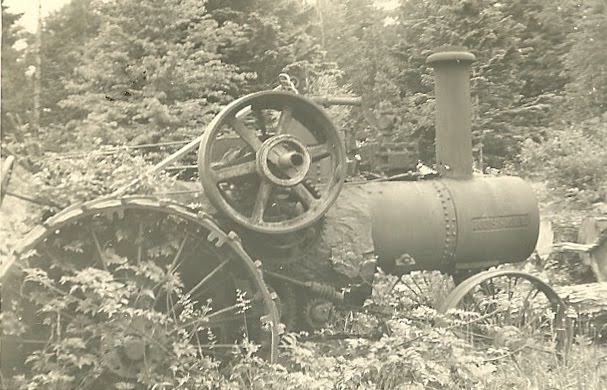 Grandpa and Uncle Joe supplemented the income from their small herd of milk cows by sawing lumber from logs on the home place. Originally, a large steam tractor powered the Huckins’ sawmill. It turned a line shaft which powered two four-foot circular saws and also caused the log carriage to move forward and backward, slicing logs into rough lumber.
In about 1945 they replaced the tractor with a steam boiler and built a brick furnace beneath it to burn slabs of wood from the mill. The fire boiled the water and produced steam to power a stationary single-cylinder steam engine. As a ten-year-old boy, I was fascinated as Grandpa and Uncle Joe heated heavy steel rods in the forge and used an anvil to shape them into hooks. The hooks suspended the huge boiler from the roof timbers of the sawmill.
 The Huckins' sawmill, with my dad in his Sunday clothes standing on a log in the log pond.
 What fun! A side benefit of owning my own steam engine was a lesson in economics. Wood alcohol could only be obtained at a local drugstore at the whopping big price (in 1945) of ninety cents a pint plus three cents tax. That left barely enough of a dollar bill to buy a nickel candy bar. Since money was in short supply my steam engine seldom got fired up. Perhaps that was why it was still in working condition years later when my mother passed it on to the Washougal museum.

The toy steam engine
Subscribe to:
Posts (Atom)