Followers

Wednesday, October 30, 2013

Putting Families Together


There’s a longing in all people to belong. God planned that this longing should culminate in marriage and family.

Because we’re human and subject to the weaknesses and poor judgement of humanity,  the blueprint often gets messed up. Children are left orphans or are abandoned by parents. Marriages end through death or divorce. Families can get complicated.

When my first husband died, our young adult children were left with a dad-sized hole in their lives. After I married Hank, though he could never exactly fit that hole, he did his best to love my kids. And I did the same for his five children, each of whom had their own tales of hurts from the past. With all the relationships represented in the lives of each of these nine people (Hank, myself, and our combined seven offspring), there’s room for a lot of family building and rebuilding.

When he married Lois, Hank was raising four small children by himself. Lois had a toddler son, Nathan, born after her first husband abandoned her. Hank adopted Nate. Nate’s birth father went on to marry and father other children, but Nate did not know them until he attended college near where they lived. Then he met his half-brother and was delighted to find out how many interests and values they share. Now Nate spends vacations with his brother and family.

When my son Rob married, he also adopted his wife’s child, my granddaughter Marva. Lydia had a son too, who was being raised by his birth father. We saw him occasionally during his growing up years, but not until he was an adult and his father died, did he really become part of our family. He’s a wonderful, thoughtful young man, a grandson I’ve only recently been able to claim.

Hank’s daughter Carmen got married at age 18 to Ben, who was raising three children alone. Those children knew there were three half-brothers born later to their mother, but what they didn’t know until recently was they also had a half-sister who’d been given up for adoption and raised as part of a happy, stable family. Through the wonders of modern technology, Kendra discovered the three half-brothers and through them, the three siblings Carmen had raised and then adopted as adults after Ben died of cancer. We were there at the family picnic to meet Kendra, her husband and her children and watch the reunited siblings and their children get acquainted. What a joyful time!

Some years after our marriage, we attended a family reunion in Hank’s home town. An honored guest at that reunion was an 82-year-old cousin, Jud, who’d just been discovered by the family. Born during the depression to a destitute mother, he’d been given up for adoption to a loving family. He grew up never knowing he had six younger brothers and sisters living nearby, nor did they know about him. While his daughter was using the Internet to research family geneology, she discovered his connection to Hank’s family. We looked on as Jud and his siblings met and caught up on all the years of unshared history. Proof of relationship came through the uncanny resemblance between Jud and Hank’s cousin, John.

The Bible says God puts the lonely in families. I think it’s delightful to watch the many ways in which he does it.

Friday, October 11, 2013

Good Samaritans to the Rescue

Last Saturday's picnic turned out quite differently than planned.

The October weather couldn't have been lovelier as we headed out to look for a picnic spot along the Mountain Loop Highway. But the parks we passed were closed for the season. As we passed the road  leading up Mt. Pilchuck, I suggested to Hank we turn there. We could always eat our sandwiches in the car, and we'd have a grand view.

As the potholed road wound up the mountain, I remembered all the times in the past I'd been up that road, and the times in my youth before the road existed, when we started at the river in the valley below and hiked five miles or more to the lookout at the top of Mt. Pilchuck. We shared the trail with very few people then, but things have changed. The hike is shorter now. It's one of the most popular trails in Snohomish County.

As we neared the end of the road, we passed a spate of cars coming down. Good! That should mean plenty of parking would be available. But no, the graded area at the end of the road was filled with vehicles. There must have been hundreds of people up on the mountain. (We found out later that there'd been a wedding in the woods along the trail. The cars that passed us were probably guests leaving. Someone told us they'd seen the bride and groom, in jeans and hiking boots, put their balloons and leftover wedding cake in their car. Then the bride tied her hair up in a pony tail and away they went, up the trail!)

Hank spied a place large enough for our car and one other, if he nosed it up on a rocky berm.
So he did that, and suddenly we felt a front corner drop a few inches. A Ukrainian boy passing with a group of other young people called out, "You popped your tire."

So we had, the first flat tire in the twelve years we'd had our Honda Odyssey. One of the young people offered to change the tire for us, but it was two o'clock and Hank declined the offer, needing some food in his stomach before doing anything else.

We hauled our folding chairs to the brink of the overlook and enjoyed a picnic with a view. The valley where I grew up spread below us. Beyond Green Mountain to the north, we could see the Cascade peaks on into Canada. To the west was Puget Sound with its islands, to the south, the Olympic Mountains. Somewhere out there in the haze lay Everett and other communities. And behind us loomed the rocky crest of Mount Pilchuck with all those hikers.


We finished our coffee and turned to the task at hand. There must be a spare tire and a jack somewhere in the car, although we'd never used it. I pulled the manual from the glove compartment and discovered they were stored in a compartment between the front two rows of seats. After a struggle, we dislodged and hauled them out. The spare with its wheel was about half the size of the other tires. The jack looked like a toy. And the wheel with the flat looked huge and heavy.

About then, a young man came down the trail to the car parked next to us. He saw our problem and offered to help. He sat on the ground and turned the wimpy little crank on the jack around and around, lifting the big van until there was room to loosen the lugs on the tire and remove it. He put the spare in its place and lowered the car to the ground. The tire had seemed firm, but under the car's weight, it too went flat. We asked people arriving and leaving if anyone had a tire pump, but no one did.

"No problem," Hank said. "We have Triple A." He thanked the helpful young man, who left. Hank went to the brink of the overlook, the only place our phone got reception. But he couldn't get through. A truck pulled into the empty spot beside us with a couple just out for a drive, not a hike. The man offered his more powerful cell phone. Then we waited and waited for the AAA receptionist to call back with news that a tow truck was on its way. The couple waited with us. Finally she called back, apologetic. Five or six companies had refused the job. They would not take their trucks out on a graveled mountain road and risk damaging them.

So the helpful Samaritan, Brock, put our tire in his truck and drove it and Hank down the mountain and back to Granite Falls, a round trip of about 35 miles. They got there just as the mechanic was closing up shop. He discovered a rock puncture in the tire, repaired and aired it up, and Hank and Brock returned to the parking area where Brock's friend Linda had been keeping me company. By the time they got there, the temperature had dropped. Linda and I were sitting in the car, watching hikers pour off the mountain, hoping the men would get back before dark so we wouldn't be alone.

Brock soon had the tire back on the car. Though he didn't want to take it, we gave him the little money we had with us to help pay for his gas. He and Linda waved and headed down the mountain. By the time we reached the main road, darkness had descended and they were long gone.

We are so grateful for the good and generous people that still walk the earth. Thank you, Brock and Linda and all the other good Samaritans for "paying it forward." When our turn comes, I hope we won't need to change a heavy, dirty tire like you did for us.


Sunday, October 6, 2013

Powerful Photos

Image of baby reaching: Need a hand?
As we drove home from Camano Island this afternoon, we found the intersection of Marine Drive and Highway 520 lined with people of various ages, each holding a poster. Some said simply, "Jesus Heals and Forgives." One said, "Abortion Stops a Beating Heart." The one that held my attention showed a little child reaching for its mother's hand. The caption read, "Take my hand, not my life." My eyes flooded with tears. That one photo said everything to me that can be said about abortion.

Something very similar happened yesterday. We'd reserved the beautiful fall day for a picnic at Verlot, but arrived in Granite Falls just as the annual Railroad Days Parade was making its way through town. Trying to find our way around the blocked-off route, we found ourselves facing the oncoming parade. One single parking spot waited just ahead. So we grabbed it and walked a half block to a perfect, unobstructed viewing spot, where we watched participants turn a corner and march on to the disbanding area.

Just as we got to the corner, a large group of adults and children arrived, preceded by a sign saying they were from Monte Cristo Elementary, a school nationally recognized for their efforts to honor military veterans. The marchers carried oversized portraits of Washington military people who have given their lives in service to their country. Again, tears threatened to overflow. Real people. Real lives, cut short so that we could enjoy these beautiful fall days with the freedom to stand for what we believe.

Lord, thank you for people. Each one is precious to you. Thank you for photos. And thank you for speaking to my heart through the faces I see in photos.


Sunday, September 15, 2013

Youth on Age Trail


One of Snohomish County’s little treasures, The Youth on Age Trail, is easily bypassed on the way to better known hiking spots along the Mountain Loop Highway. But it’s a perfect place to stop and explore on a sunny (or misty) fall afternoon, especially if you have children or disabled people along.

The short loop, approximately a quarter mile long, is paved except where, back in the 1980s, the rambunctious Stillaguamish River cut into the old-growth forest and carried away a piece of real estate. The repaired section is still wheelchair-passable. Toppled trees have been left in the riverbed to provide fish habitat. Four-inch fingerlings dart through shaded pools beneath them.

The trail’s name comes from the Youth on Age, or piggyback, plant which is common in the area. Late in the summer and into the fall, new leaves grow from the base of the older, heart-shaped leaves as if they’re riding piggyback. (Don’t dig them here, but these plants do well in the house if transplanted into a pot.)

Kids will enjoy looking for seedlings growing on nurse logs, mossy logs which hold the baby trees up into the sunshine and nourish their roots while their rotting wood slowly turns back into soil. If you look for them, you can find mature trees lined up along the resting place of their former nurse log.

Thickets of vine maple add color to the understory in the fall. Some of the spruce and fir giants towering above them have been growing since Columbus discovered America. You can marvel at the spreading root systems of trees that have fallen. Where logs were cut away from the trail, you can count the rings that tell their age.

There are picnic tables and vault toilets at the trailhead. A side trail leads off to the river. To get here, drive eleven miles east of Granite Falls along the Mountain Loop Highway, then seven miles beyond the Verlot Public Service Center. The parking area and trailhead is on the right.

Come walk through the woods

Color and pattern

Texture everywhere

A nurse log with baby firs

Log jams make good shelter for baby fish

A mystery! What made the pile of fresh sawdust?

Little homebuilders...carpenter ants

Each ant drops its mouthful of sawdust on the pile and vanishes, to be replaced by a constant stream of others.

Old growth trees on the riverbank

Pitch dripping from an old wound on an old-growth spruce

Sunday, September 1, 2013

MAKING GOOD USE OF RESOURCES AT KAKO

Years ago, Edie Smith, an Eskimo friend, could not grow a garden on her forested hillside property in interior Alaska. When a friend parked his car in the only sunny spot in her front yard and left it there for the summer, she created an improvised greenhouse by planting tomatoes inside in boxes of dirt. The tomatoes loved it, filling the car with a jungle of greenery and ripe fruit. Edie knew how to make the most of what she had.

Like most people in Alaska’s wilderness areas, the Penzes at Kako Retreat Center make do with the resources on hand. When the center was just beginning, Dave and Vera made good use of the old buildings from Kako’s gold mine days. They lived in one of them. They used others to lodge the first campers. They tore some apart and reused the lumber for new buildings. Sometimes Dave bought an empty building in one of the villages, disassembled it, and brought the materials to Kako for reuse.

Now they have their own lumber maker, called a Woodmizer. They cut logs from the  property, saw them into rough boards, and plane them for use in building projects. When we were there, they were making lumber to build a shed around the Woodmizer where it stands. The building will be big enough to store and dry a lot of lumber.

Over the years a lot of equipment has worn out. There is no place to send scrap metal for recycling, but that’s all right. Broken-down snowmachines, four-wheelers, even trucks and other large equipment are parked out of sight, ready to serve as parts-donors for other machines still in use. I saw a good-sized “boneyard” of scrap metal where the men can scavenge for the just-right piece of metal for projects in process.

When everything you need must come by small plane or by barge up the Yukon River, then be dragged by sledge over an 8-mile trail, one develops great skill in reusing, recycling, taking apart and rebuilding. Here are a few photos of some clever ways of repurposing materials at Kako:

The Woodmizer with a log in place, ready to make lumber. The drying-storage shed is going up around it.

Hank sorts nails and screws into vegetable cans from the kitchen. (He's taped one of each kind to the outside of its can.) Dave pays a small amount for the nails that get spilled and swept up from the floors of hardware stores. Once sorted, they're ready for Kako's use at much less than full price.

Playground area for summer campers. Tires are worn out, but still fun to play on.

Storage area along the runway. Old freezers and refrigerators are reused for dry storage for small parts and pieces.

A broken shop broom and an old handle get together.

What do you do when you want to pick berries in the rain? You tear the bottom of a garbage bag open and cinch the ties around your waist. Now you can kneel on the tundra and not get wet.

The laying hens live in the shed. The young chickens live in the repurposed camper. They're fed the kitchen scraps.

Hank made this shop table on the spot when Dave noticed a piece of pallet lying there and said, "That would make a good table top."

This scavenged street light was spotted high on the wall of one of the shops. It can brighten the shop or be moved anywhere someone needs lots of light.

A plastic barrel cut to shape protects the innards of Kako's Cessna 182 while the engine is being rebuilt.

A fabricated metal water tank sits on four oil barrels next to the garden. Gravity feeds the water to irrigate the garden. The tank is filled from the canoeing pond which is out of sight below the brush.

Wednesday, August 28, 2013

Ladies' Berry Picking Retreat at Kako, 2013

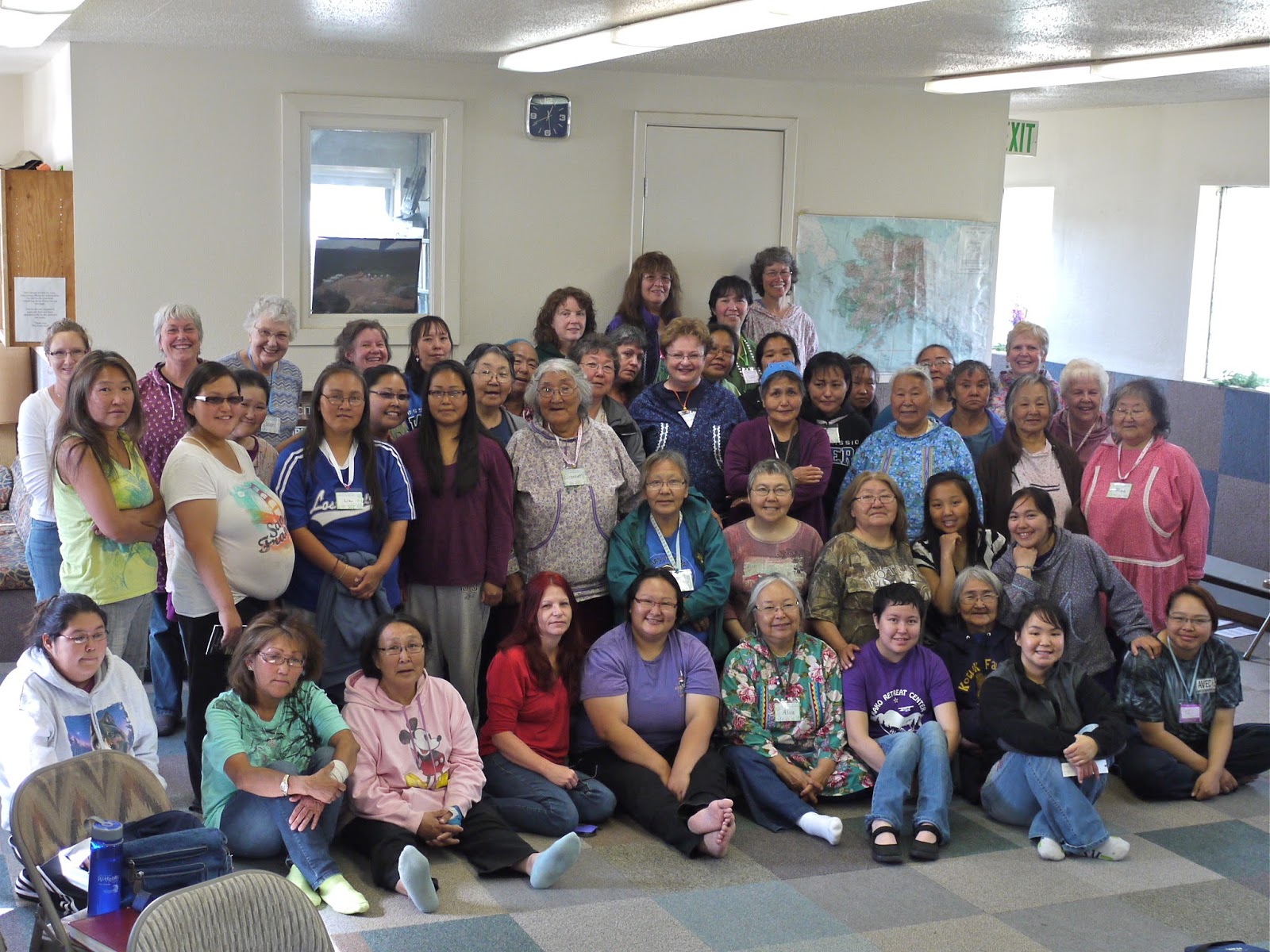
Kako Retreat Center's most popular event is the annual Ladies' Berry Picking Retreat. This year 42 women from about 12 villages were flown in for three days of fellowship, teaching, and berry picking. Since berries are the only fruit that grow in western Alaska, wild berries are a highly prized part of the diet, and they're easy to find at Kako.

Vera Penz and Lynda work on name tags for the participants.

Brenda holds one of the gift baskets each woman found on her pillow.

Shea decorates with wildflowers.

These pretty teens were some of the youngest guests.

Off to pick up another three ladies. The weather was rainy, but not bad enough to keep the two planes from flying.
These women were the first to head for the mountain. Bill gives them a ride on Kako's all purpose vehicle, a four-wheeler.
Wild Alaska blueberries grow only a few inches high in the tundra.


Picking berries on the mountain above Kako. Kako's cross is visible on the distant hill.
Recording memories. The red metal box is a berry rake, used to make the job go faster.
An unwritten rule everyone respects: Elders go first. These Eskimo women are wearing kuspuks, or summer parkas.


Jeannie, our speaker, grew up in the villages. Here she visits with old friends.

Vera's daughter, Debbie, also grew up in Alaska. Here she receives a handmade jacket from a friend.

Berries bagged and ready for the freezer.

Lovey (back to camera) is telling the ladies of her recent discovery that young people in the villages are ordering dangerous prescription drugs over the internet, using debit cards. The drugs come from foreign countries with no questions asked. Kids as young as elementary age quickly get addicted and many are dying. "Check your debit statements," she says. "Please, tell your village councils we must work together to stop the loss of our young ones."

Irene sings a hymn for us in her "up north language," Yupik Eskimo.

Jeanne uses handmade visual aids to illustrate her teaching.

All the women and staff at the close of the retreat.

Raining again, but it's time to go back to the villages. Brenda helps one of the women carry her berries and belongings to the plane.

Thursday, August 22, 2013

Kako's Beginnings

 
Kako Retreat Center (KRC) began in the 1970's as a dream of a young school teacher-missionary-gold miner at Kako, on the Yukon-Kuskokwim Delta of western Alaska. When Ed Hooley died in a plane crash, Dave Penz took over the mining and carried out Ed's dream of establishing a place where people of the delta could come for spiritual teaching and relaxation.

Kako Retreat Center (KRC) is located on the Yukon-Kuskokwim Delta in Western Alaska. No roads connect it to the rest of the world.


The gold mining equipment was loaded onto a barge in Fairbanks, carried down the Yukon to the river bank 8 miles from Kako, then pulled on sledges to the site by a bulldozer. Dave says the equipment could be back in production in just a few days. A lot of gold was taken out of the ground which now lies beneath the airstrip, but for now, low prices and high costs make mining impractical.
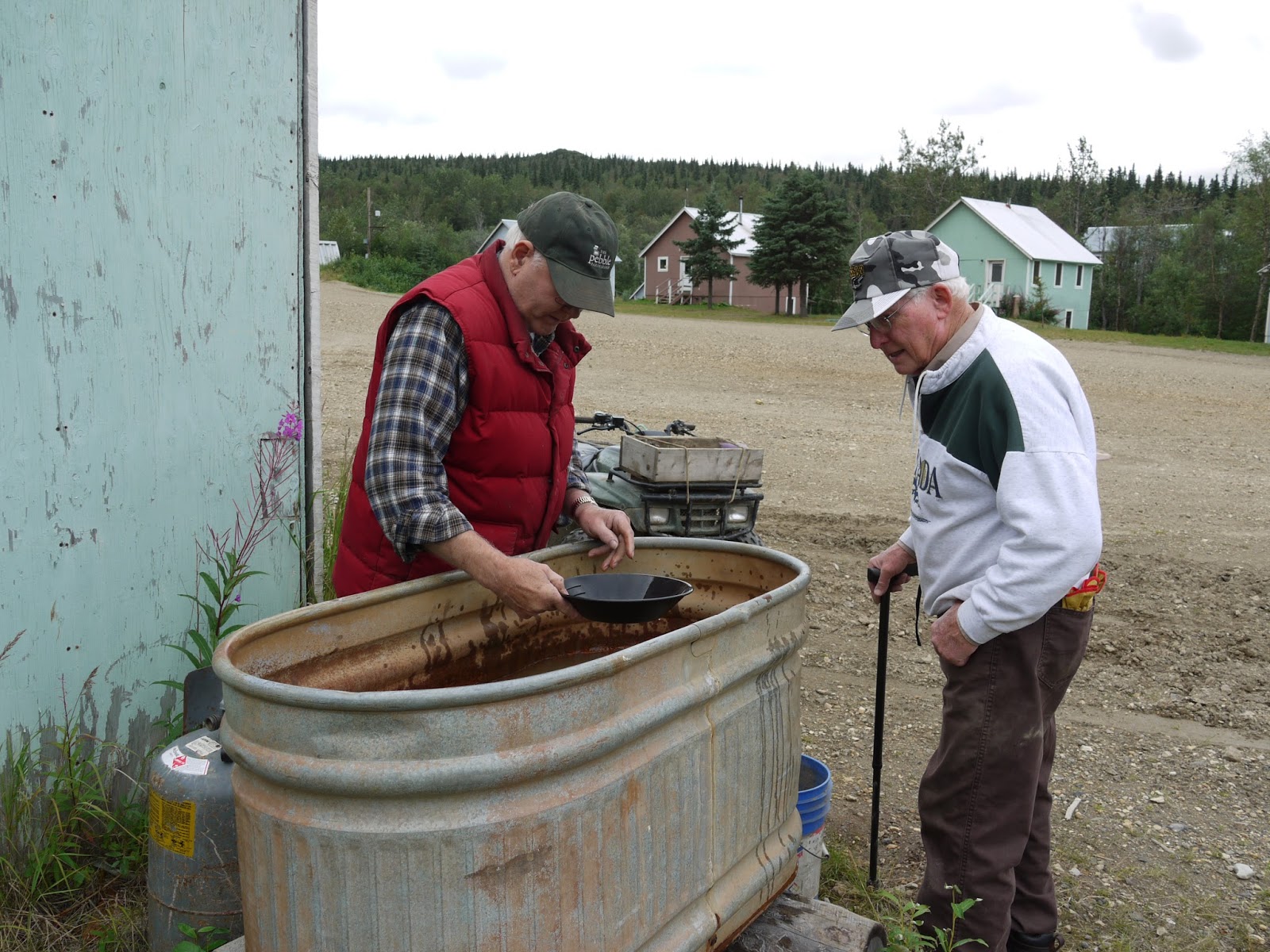
 Dave showing Hank how he pans for gold in a horse watering trough.

The gold in this pan is tiny specks and flakes. It came from floor sweepings in Dave's metal working shop.

Picking wild blueberries along the track that leads to the Yukon River. The no-see-ums won this battle.

When we tried to back down the muddy road in the 4-wheel drive truck, we got stuck.
Abe, a pilot from Nunivak Island, and his wife, Mona, came with us to check out the berries. He got us unstuck and backed the truck all the way to the gravel runway.