Followers

Friday, November 14, 2014

Making Memories with Family Traditions


Some time ago I promised to share more about last summer's trip to Innisfail, Alberta. As always when we are with our Wislen and Shaw cousins, the trip was not so much about the travel but about sharing experience as family. While we were visiting cousins Vicki and Allen, a friend brought them  fresh peaches and other fruits that don't grow on the plains of central Alberta. The fruit was ripe and wouldn't wait, so we had a canning party!

Hank's job: peeling peaches
Vicki and daughter Katrina starting the kitchen prep

Barbara and Hank trying to keep up with the kitchen crew

Katrina and her mom celebrate the results of our work with pictures


A tradition when our Canadian family gets together is the evening hymn sing. William is the chief pianist and the rest of us choose the songs. He's adept at adding fun flourishes to the good old hymns. The beautiful voices blend and harmonize. The television in the corner is mainly used for DVD's. Who needs tv when you can make your own music?


 Another tradition beloved by the younger folk is the "Root Beer Tasting." It's similar to a wine tasting, with overtones of spoofing. Cousin Bill brings the root beer from a Washington state specialty store which sells dozens of varieties of the drink. The objective is to evaluate the different kinds Bill has picked out and decide which are the favorites.
 
William gets in the mood with a fake mustache, plus extras for eyebrows.

Clarissa, Troy, and Katrina wait to get started.

This takes thought....

and serious consideration!
Too much root beer!

 My favorite part of last summer's trip was not the beautiful scenery or the places we visited, memorable as all that was. It was being part of a multigenerational family, sharing their faith and their creative goings on. Thanks, Vicki and Allen and all of your family members, for including us!

Tuesday, November 11, 2014

Creative Gifts for Christmas or Anytime


 Wouldn't you like to give or receive a collection of personal care products like this? Or tuck something from the assortment into the toe of each Christmas stocking you fill?

My creative stepdaughter Carmen runs a summer farmstand on her Emerald Aisle Farm (the former Hardpan Hill). Besides garden produce and flowers, she offers mini greeting cards, specialty soaps, candles, lotions, lip balms and scented oils...all but the oils handmade. These specialty items are also offered in her Etsy shop: https://www.etsy.com/shop/asunlitwalk?ref=hdr_shop_menu .

(The round tins can hold either candles or Carmen's own concoction which she calls "Extreme Balm." The balm is healing and soothing to sensitive or irritated skin. She applies it to her hands before putting on her garden gloves or starting other outdoor chores. My husband says it feels great on his chapped, dry hands.)

Carmen says her Emerald Aisle Farm products are made with pure Washington rainwater☺and other healthy, luxuriant, and conditioning ingredients.  A one pound assortment of soaps sells for $20, one and a half pounds for $28, plus $5.95 shipping for either size. Visit the Etsy shop for other prices, or to order.

 Carmen uses scented oils in many ways, one of them a version of aroma therapy. She says smell the oil first, and if you love it, use it. Adding a few drops to the melted wax at the top of a candle scents the room for hours. (Blow the candle out first before adding the oil, then light it again. Some oils are flammable.) By law the oils must be sent by UPS or Fedex.

Recipe for Emerald Aisle Farm Potpourri:

* Collect plant materials like petals, cones, seed pods, short pieces of thin twigs, mosses from logs or trees.
*Lay out to dry in single layers for two weeks or longer.
*Place in a coffee can with lid.
*Add one dram oil (1/16 ounce) per 1 cup dried material.  Shake it twice daily for a week.
* Add more petals and other materials. Don't fill the can more than 3/4 full. Shake it daily for two weeks.
*If the scent isn't strong enough, add more scented oil. The secret to holding the scent is to put it on something with pores, like the sticks or cones.

Wouldn't it be fun to make potpourri with the kids for gifts?

Watch Carmen's blog below for more creative ideas.


Thursday, October 30, 2014

Adventuring at Cama Beach, 1930s Style

 Back in a slower, simpler time, moms and dads packed food, dishes, bedding, vacation clothes, and kids into the Model A and headed for one of numerous resorts dotting the shores of Camano Island. Cama Beach Resort was a favorite of many people in the 1930s. A double row of sturdy cedar cabins lined the shell and gravel beach at the foot of a steep, forested hill. Vacationers could rent a boat or bring their own. They could go fishing or crabbing, beachcomb or sunbathe or birdwatch. In the evening they could sit outside their cabin and watch the sun set over Whidbey Island, or if it rained, gather around the table inside for board games.


Cama Beach cabins overlooking Saratoga Passage
Most island retreats faded into disuse with the coming of bigger, fancier resort destinations. But privately owned Cama Beach remained in the hands of the original family owners until sisters Karen Risk Hamalainen and Sandra Risk Worthington decided that, rather than sell their beautiful piece of property for commercial development, they would allow the public access. They deeded it to the State Parks Department with the stipulation that the resort be restored for use as a park.
The work took 18 years, but in 2008, Cama Beach Resort reopened as Cama Beach State Park.

Restored cabins at Cama Beach

On summer weekends, the refurbished cabins are reserved months ahead. Weekdays are not so busy. In late autumn, not only do prices go down, but the resort is much less crowded. We reserved one of the seven deluxe cabins for a mid-October Sunday overnight (deluxe means there’s a tiny bathroom, with a shower, toilet, and an Amtrak-washroom- sized sink). The standard cabins share a nearby washhouse.

The park also hosts a branch of the Center for Wooden Boats.


Each cabin sleeps at least four, and each bed has a brightly-colored quilt, hand-made and donated by the Cama Beach Quilters, whose items are also on sale at the park’s store-museum.
Kitchen area, with sink, microwave, coffee maker, and refrigerator
As people did in the 1930s, we brought our own food, dishes, bedding, and towels. A free shuttle van carried us and our camping goods from the parking area on the hill down to our cabin. We stowed everything inside, then hurried out to enjoy the beach while daylight lasted. If we’d been earlier, we could have hiked some of the miles of trails through the woods. We ate dinner at our picnic table beside the beach while the sun sank behind Whidbey Island.  We weren’t entirely disconnected from the world.  I checked to see that our only electronic gadget, the cell phone, had reception, then tucked it away.

Following our tracks back to our cabin
The view from our picnic table


The shelves in our cabin held an assortment of donated books and board games. We enjoyed cocoa and conversation over a long game of tri-ominoes and called it a day.

The park is quiet in the off season. We heard no neighbors scraping chairs across their floors or kids romping around the cabins. Indoor light comes from energy-efficient electric bulbs, but outdoors flashlights are necessary after dark. Once the sun disappeared, the only light came from a sliver of moon between clouds. There were no traffic sounds, no  train whistles...only an occasional plane overhead, and the splash of waves on the beach. Peace and quiet...exactly what we’d hoped to find, just as did October visitors, decades ago.

Google Cama Beach State Park online to plan your own get-away.

Saturday, October 4, 2014

How to Save $ on Souvenirs


Part of cousin Vicki's sand collection

If you travel, you probably like to bring home souvenirs to refresh the memory of your experiences. 

I think of the time some people came to visit us when we lived in Alaska. We eagerly showed them as many places of interest as we could, pointing out some of the genuine made-in-Alaska artifacts we thought they might like to take home with them. But the woman wasn't interested. She had her heart set on a beautiful, expensive, ruby glass bowl that she could have found in any fancy hotel's gift shop and that's what she bought. Her passion happened to be glassware.

My own souvenirs are usually free for the taking: interesting rocks, shells, seedpods or cones, anything that reflects my passion for nature.

My Canadian cousin, Vicki, likes God's creations too. But whereas I eventually discover my souvenirs forgotten in a jacket pocket, Vicki displays hers in unique and beautiful ways.

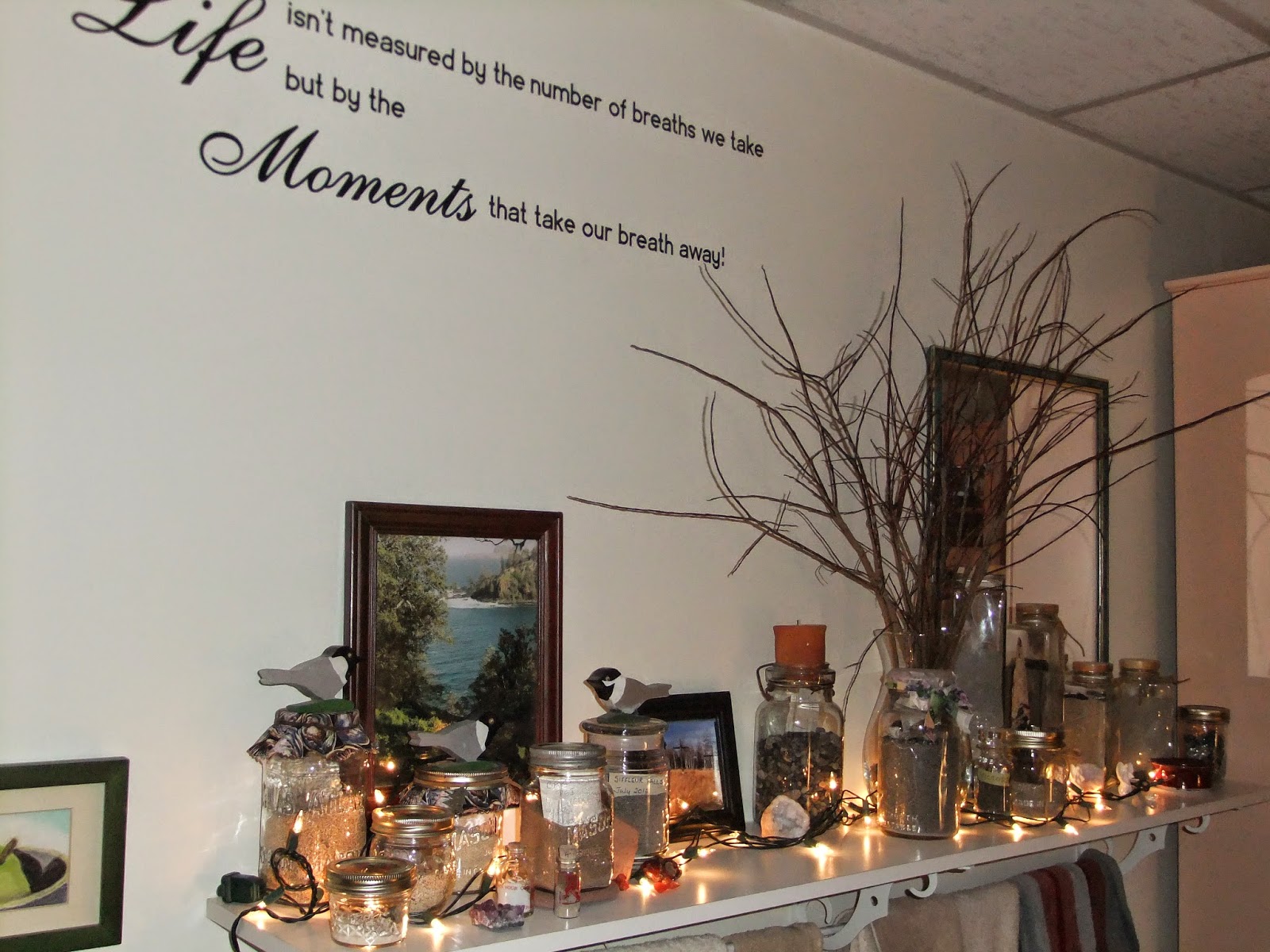
She collects sand from the places she visits. She pours each kind into its own glass container, with a small label inside reminding her where she found it. On top of the sand she places shells, pebbles, or other natural items from the same area. Each kind of sand reminds her of one of the beauty spots to which they've traveled, as well as the enjoyment of the search.The containers can be any shape or size, as long as they're clear glass to show off the color and texture of the contents. And each must have a lid.
Vicki even brought back sand from Norfolk Island, settled in 1856 by descendants of Bounty Mutineers.

Vicki at Lac la Biche, Alberta, searching for the best sand.
I brought home a handful of tiny pebbles to remind me of this just-hatched Lac la Biche sandpiper hiding in his rocky nest.

Monday, September 29, 2014

What's to See on the Road to Innisfail?

We're finding it no longer as easy as it used to be to take long road trips, but it’s worth the effort when one shares the fun and the driving with good friends.

Bill and Barbara are not only good friends, they are cousins and our trip to Innisfail, Alberta, this summer was not the first we’ve shared with them. Bill’s sister Vicki and her family are also good friends and the 800-mile drive north to their home in Alberta, Canada, can be counted on to deliver lots of good times.

Here are a few photos from the driving part of the trip. We took the North Cascades route, past the Oso slide to Darrington and then over the mountains to Twisp so we could see for ourselves some of the damage left by this summer’s wildfires. From there we drove through the beautiful Canadian Rockies to Calgary and north over Alberta’s rich farmland to Innisfail, a small town with much besides its charming name to recommend it.

I’ll share some of our experiences in the next posts. Meanwhile, hope you enjoy the pictures!

At the Washington Pass overlook on the North Cross Cascades Highway

Barbara and Hank on the overlook trail

Weather beaten snags look down on the road we'll soon be driving

Stopping for construction where fire, then flooding damaged the road over Loup Loup Pass

Following the pilot car past a washout and mud slides

A roadside picnic in southern Alberta

Passing scenery on the prairie near Innisfail

Heading home with the first snow of the season on the Rockies

Lunch with a view at Cranbrook, B.C.

A rest stop with a view along Route 93
The Columbia River has its source in Columbia Lake, behind us. It flows north, then south, west, south and west again until it reaches the Pacific Ocean.


There are cops and speed limits even on the wide-open roads of north-central Washington, While our driver explained our transgression, I snapped these combines harvesting wheat.

Whirlwinds  (dust devils) move dirt from one place to another.

A friendly horse outside of Waterville

The textures of harvest time

Shadows of evening coming off the Columbia Plateau near Wenatchee

Full moon over Leavenworth

Thursday, September 25, 2014

Created for Light


A friend reminded me of something today I needed to hear. We’ve reached the stage of life where more and more of the important people in our lives are going ahead of us into eternity. Many who are younger than we face serious health problems. It’s harder than it used to be to maintain an optimistic attitude. Grief seems to lurk behind every silver lining. But my friend said: We are created for light and joy, not for darkness.

We wouldn’t be human if we didn’t grieve, but gratitude for what we still have and for what lies ahead does a lot to dispel the cloud of pessimism the enemy would use to shut out our joy.

Hank’s mother found these words in a Dear Abby column years ago. The author wrote the lyrics for his wife of 60 years. The paper is yellowed and brittle, but his thoughts are ageless.

    AUTUMN DAYS
        When autumn days remind us that the summertime is gone
        And the shadows show the sun is on the wane,
        It seems so easy to forget that life continues on
        As we revel in our strolls down mem’ry lane.
        But then I stop to reason that living knows no season,
        And realize our numbered days are few.
        That’s why I don’t recall if summer skies were gray or blue
        But live each lovely autumn day with you.

                    Francis Stroup, Dekalb, Illinois
                    ©Universal Press Syndicate   


Wednesday, September 17, 2014

Pickled Beets and Our Funny Garden

Our untidy garden is just right for two people.


Should I make pickled beets this afternoon, or should I write about the beets and other edibles our pocket-sized piece of ground produced this year?  My blogging has been as haphazard as my gardening this summer. But our funny garden has been at the top of my long list of possible blogs for weeks, so maybe I’ll write and then pickle.

Potatoes that grew in the rhubarb patch.
Hank planting ever bearing strawberries last spring


Our garden is not one of those orderly works of art I admire in other peoples’ yards, with neat green rows of veggies laid out in geometric perfection. Beets, carrots, herbs, and squash are more-or-less confined to the big wooden box Hank made so I could plant and weed standing up. For most of the summer, peas climbed chicken wire trellises crowded between the apple tree and the blueberry bushes. Raspberries ran wild along the back yard fence and the rear of the garage. Wherever we found an unplanted square foot of ground, we tucked in a potato or two. As the zucchini finished its season the winter squash we’d planted along the side fence scrambled into the garden box to take over the zucchini’s space. And cosmos and nasturtiums seeded themselves to add color in unexpected places.

Swiss chard that survived the winter in a sheltered spot by the house came back this spring. If the bugs didn’t like it so well, we’d have had a fine crop to eat ourselves.

We had pots of tomatoes on the back porch, strawberries along the driveway, and flowers everywhere.

The wild shrubs in the front yard which we planted as tiny starts in 2009 have become near-trees. I feel like we no longer manage our growing things. They’ve taken control and dictate how we spend our time, or at least, how we should spend our time.
Wild roses bloom in the front yard

Our wild garden just getting started
Son Rob, our landscaper, with the results of his handiwork, 2011

My favorite "shrub", an American cranberrybush

Our wild garden this summer


I know we should ruthlessly tear much of our funny garden up by the roots and return it to beauty bark and grass that needs no more than a weekly mowing. But come next spring, we’ll look at that empty garden box, the flower beds, then at the seed packets and juvenile plants in the garden store, and once again we’ll go overboard.

By the way, I decided to blog and pickle. Here are the results.