Followers

Sunday, September 15, 2013

Youth on Age Trail


One of Snohomish County’s little treasures, The Youth on Age Trail, is easily bypassed on the way to better known hiking spots along the Mountain Loop Highway. But it’s a perfect place to stop and explore on a sunny (or misty) fall afternoon, especially if you have children or disabled people along.

The short loop, approximately a quarter mile long, is paved except where, back in the 1980s, the rambunctious Stillaguamish River cut into the old-growth forest and carried away a piece of real estate. The repaired section is still wheelchair-passable. Toppled trees have been left in the riverbed to provide fish habitat. Four-inch fingerlings dart through shaded pools beneath them.

The trail’s name comes from the Youth on Age, or piggyback, plant which is common in the area. Late in the summer and into the fall, new leaves grow from the base of the older, heart-shaped leaves as if they’re riding piggyback. (Don’t dig them here, but these plants do well in the house if transplanted into a pot.)

Kids will enjoy looking for seedlings growing on nurse logs, mossy logs which hold the baby trees up into the sunshine and nourish their roots while their rotting wood slowly turns back into soil. If you look for them, you can find mature trees lined up along the resting place of their former nurse log.

Thickets of vine maple add color to the understory in the fall. Some of the spruce and fir giants towering above them have been growing since Columbus discovered America. You can marvel at the spreading root systems of trees that have fallen. Where logs were cut away from the trail, you can count the rings that tell their age.

There are picnic tables and vault toilets at the trailhead. A side trail leads off to the river. To get here, drive eleven miles east of Granite Falls along the Mountain Loop Highway, then seven miles beyond the Verlot Public Service Center. The parking area and trailhead is on the right.

Come walk through the woods

Color and pattern

Texture everywhere

A nurse log with baby firs

Log jams make good shelter for baby fish

A mystery! What made the pile of fresh sawdust?

Little homebuilders...carpenter ants

Each ant drops its mouthful of sawdust on the pile and vanishes, to be replaced by a constant stream of others.

Old growth trees on the riverbank

Pitch dripping from an old wound on an old-growth spruce

Sunday, September 1, 2013

MAKING GOOD USE OF RESOURCES AT KAKO

Years ago, Edie Smith, an Eskimo friend, could not grow a garden on her forested hillside property in interior Alaska. When a friend parked his car in the only sunny spot in her front yard and left it there for the summer, she created an improvised greenhouse by planting tomatoes inside in boxes of dirt. The tomatoes loved it, filling the car with a jungle of greenery and ripe fruit. Edie knew how to make the most of what she had.

Like most people in Alaska’s wilderness areas, the Penzes at Kako Retreat Center make do with the resources on hand. When the center was just beginning, Dave and Vera made good use of the old buildings from Kako’s gold mine days. They lived in one of them. They used others to lodge the first campers. They tore some apart and reused the lumber for new buildings. Sometimes Dave bought an empty building in one of the villages, disassembled it, and brought the materials to Kako for reuse.

Now they have their own lumber maker, called a Woodmizer. They cut logs from the  property, saw them into rough boards, and plane them for use in building projects. When we were there, they were making lumber to build a shed around the Woodmizer where it stands. The building will be big enough to store and dry a lot of lumber.

Over the years a lot of equipment has worn out. There is no place to send scrap metal for recycling, but that’s all right. Broken-down snowmachines, four-wheelers, even trucks and other large equipment are parked out of sight, ready to serve as parts-donors for other machines still in use. I saw a good-sized “boneyard” of scrap metal where the men can scavenge for the just-right piece of metal for projects in process.

When everything you need must come by small plane or by barge up the Yukon River, then be dragged by sledge over an 8-mile trail, one develops great skill in reusing, recycling, taking apart and rebuilding. Here are a few photos of some clever ways of repurposing materials at Kako:

The Woodmizer with a log in place, ready to make lumber. The drying-storage shed is going up around it.

Hank sorts nails and screws into vegetable cans from the kitchen. (He's taped one of each kind to the outside of its can.) Dave pays a small amount for the nails that get spilled and swept up from the floors of hardware stores. Once sorted, they're ready for Kako's use at much less than full price.

Playground area for summer campers. Tires are worn out, but still fun to play on.

Storage area along the runway. Old freezers and refrigerators are reused for dry storage for small parts and pieces.

A broken shop broom and an old handle get together.

What do you do when you want to pick berries in the rain? You tear the bottom of a garbage bag open and cinch the ties around your waist. Now you can kneel on the tundra and not get wet.

The laying hens live in the shed. The young chickens live in the repurposed camper. They're fed the kitchen scraps.

Hank made this shop table on the spot when Dave noticed a piece of pallet lying there and said, "That would make a good table top."

This scavenged street light was spotted high on the wall of one of the shops. It can brighten the shop or be moved anywhere someone needs lots of light.

A plastic barrel cut to shape protects the innards of Kako's Cessna 182 while the engine is being rebuilt.

A fabricated metal water tank sits on four oil barrels next to the garden. Gravity feeds the water to irrigate the garden. The tank is filled from the canoeing pond which is out of sight below the brush.

Wednesday, August 28, 2013

Ladies' Berry Picking Retreat at Kako, 2013

Kako Retreat Center's most popular event is the annual Ladies' Berry Picking Retreat. This year 42 women from about 12 villages were flown in for three days of fellowship, teaching, and berry picking. Since berries are the only fruit that grow in western Alaska, wild berries are a highly prized part of the diet, and they're easy to find at Kako.

Vera Penz and Lynda work on name tags for the participants.

Brenda holds one of the gift baskets each woman found on her pillow.

Shea decorates with wildflowers.

These pretty teens were some of the youngest guests.

Off to pick up another three ladies. The weather was rainy, but not bad enough to keep the two planes from flying.
These women were the first to head for the mountain. Bill gives them a ride on Kako's all purpose vehicle, a four-wheeler.
Wild Alaska blueberries grow only a few inches high in the tundra.


Picking berries on the mountain above Kako. Kako's cross is visible on the distant hill.
Recording memories. The red metal box is a berry rake, used to make the job go faster.
An unwritten rule everyone respects: Elders go first. These Eskimo women are wearing kuspuks, or summer parkas.


Jeannie, our speaker, grew up in the villages. Here she visits with old friends.

Vera's daughter, Debbie, also grew up in Alaska. Here she receives a handmade jacket from a friend.

Berries bagged and ready for the freezer.

Lovey (back to camera) is telling the ladies of her recent discovery that young people in the villages are ordering dangerous prescription drugs over the internet, using debit cards. The drugs come from foreign countries with no questions asked. Kids as young as elementary age quickly get addicted and many are dying. "Check your debit statements," she says. "Please, tell your village councils we must work together to stop the loss of our young ones."

Irene sings a hymn for us in her "up north language," Yupik Eskimo.

Jeanne uses handmade visual aids to illustrate her teaching.

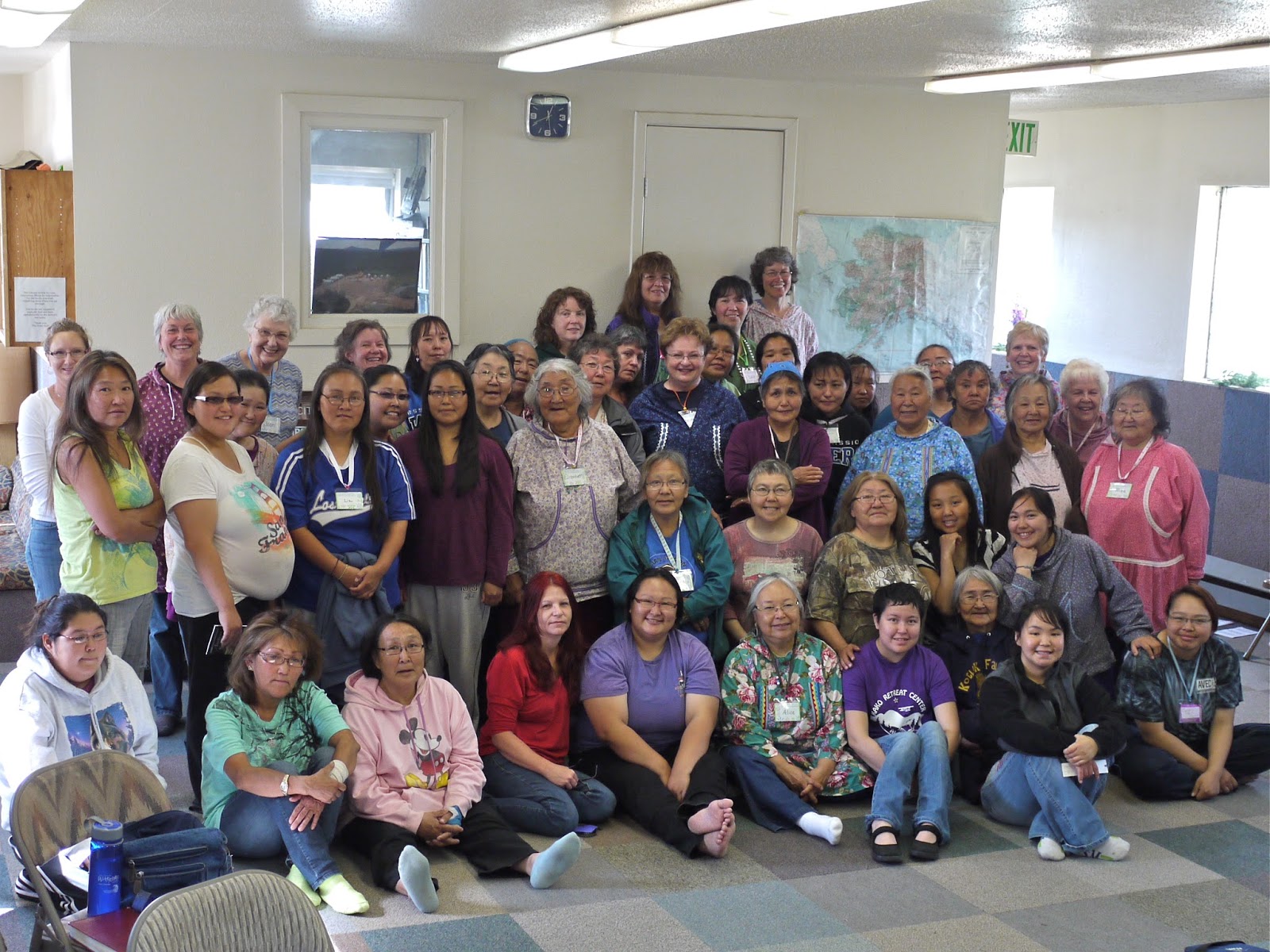
All the women and staff at the close of the retreat.

Raining again, but it's time to go back to the villages. Brenda helps one of the women carry her berries and belongings to the plane.

Thursday, August 22, 2013

Kako's Beginnings

 
Kako Retreat Center (KRC) began in the 1970's as a dream of a young school teacher-missionary-gold miner at Kako, on the Yukon-Kuskokwim Delta of western Alaska. When Ed Hooley died in a plane crash, Dave Penz took over the mining and carried out Ed's dream of establishing a place where people of the delta could come for spiritual teaching and relaxation.

Kako Retreat Center (KRC) is located on the Yukon-Kuskokwim Delta in Western Alaska. No roads connect it to the rest of the world.


The gold mining equipment was loaded onto a barge in Fairbanks, carried down the Yukon to the river bank 8 miles from Kako, then pulled on sledges to the site by a bulldozer. Dave says the equipment could be back in production in just a few days. A lot of gold was taken out of the ground which now lies beneath the airstrip, but for now, low prices and high costs make mining impractical.
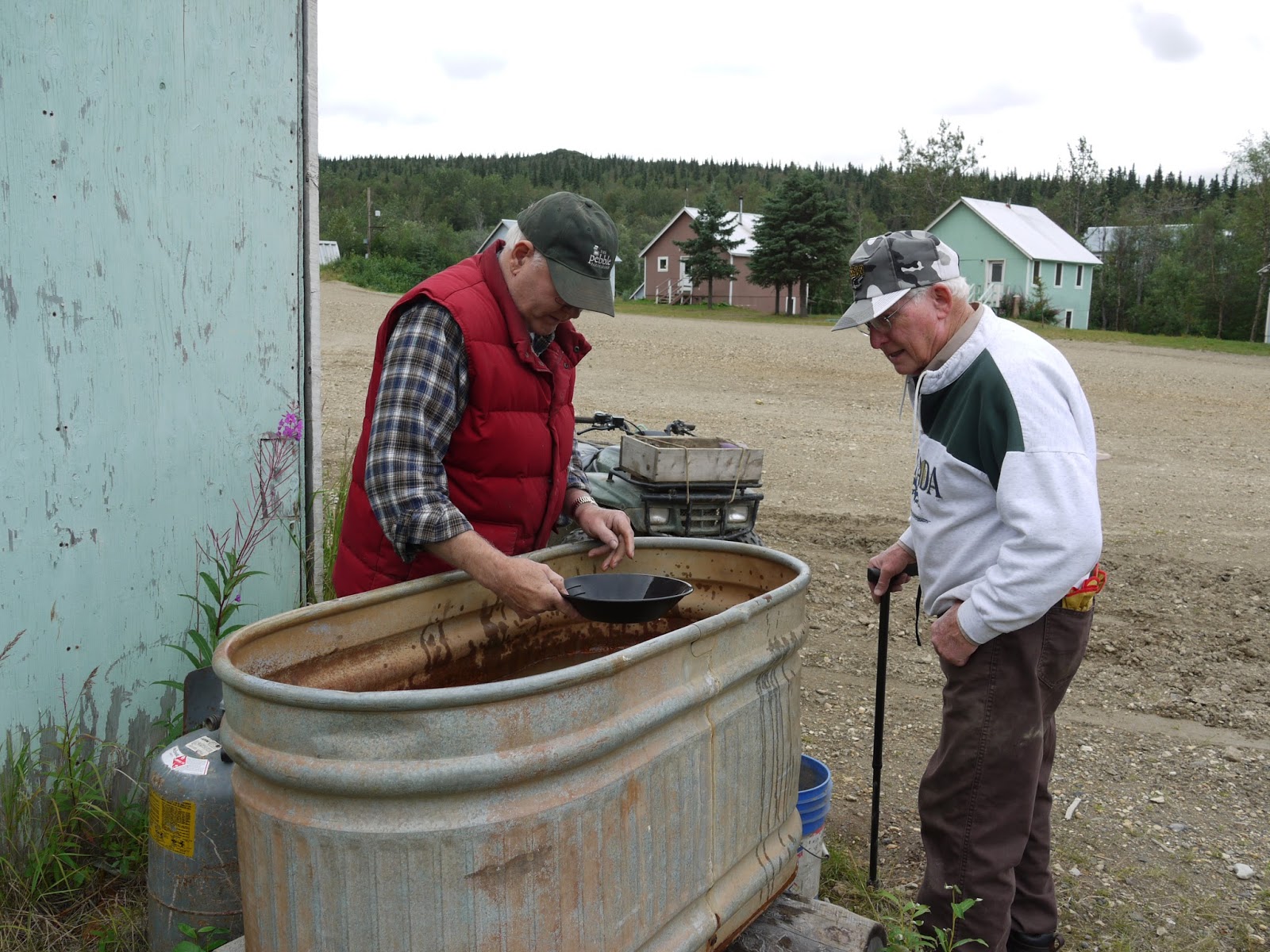
 Dave showing Hank how he pans for gold in a horse watering trough.

The gold in this pan is tiny specks and flakes. It came from floor sweepings in Dave's metal working shop.

Picking wild blueberries along the track that leads to the Yukon River. The no-see-ums won this battle.

When we tried to back down the muddy road in the 4-wheel drive truck, we got stuck.
Abe, a pilot from Nunivak Island, and his wife, Mona, came with us to check out the berries. He got us unstuck and backed the truck all the way to the gravel runway.

Friday, August 9, 2013

We're at Kako!

Waiting for a flight at the Anchorage airport

Not our flight, but one just like it. We took Era Airlines to Aniak.

You know you're in Alaska when you follow the caribou hoofprints across the tarmac to your plane.  Vera's daughter, Debbie, and her friend Linda are boarding the same plane we're on.


Kako Retreat Center on the Yukon-Kuskokwim Delta in western Alaska is like no place else on earth that I know of.

Despite being a lonely little outpost in the wilderness, far from cities and highways, it's connected to the outside world by small plane, river barges and boats, telephone, and the Internet.

Internet connections are slow...I’m not sure that these few pictures will even send. But we’re here and fully immersed in the exciting little world that is Kako.

The ceiling was 600 feet here this morning, but now I can see the top of the mountain behind us. In a few minutes the two volunteer pilots will be bringing in the first ladies for the annual Ladies’ Berry Picking Retreat. It will be a lot like other women’s retreats, with groups meeting during the day for fun activities, a special speaker, singing and visiting. Volunteers here have been planning and preparing meals, decorating tables with local wildflowers, preparing little gift bags for each attendee, making programs and fancy name tags.

There will be differences too. The 50 ladies expected are coming from 8 or 10 different villages (the first to arrive will be brought from the farthest away communities). All of these villages are off  the road system. And the activity to which women most look forward is the hike up that mountain behind us to pick wild berries. We’ll be up there in the tundra above timberline for much of the day, filling buckets with Alaska blueberries and salmon berries (really cloudberries, which are salmon colored and grow one to a plant only inches off the ground). Those berries will provide treats for their families next winter.

I’m off...want to be on the airstrip with my camera when the first ladies get here!


Monday, July 29, 2013

Adventure Ahead in Kako, Alaska

This perfect weather makes it hard to sit at my computer and faithfully churn out blog posts, although I’ve tried. Half-a-dozen posts wait to be finished and shared with you. I promise, I’ll post this one. I want you to know about Kako Retreat Center. Hank and I are looking forward to the adventure of our lives this month when we fly to Alaska for the annual Ladies’ Berry Picking Retreat.

Where in the world is Kako? Well, Kako Retreat Center is in Alaska, about 400 miles from the nearest road that could connect it to the rest of the world. It’s on the site of an old gold mine six miles from the Yukon River, on the Yukon Kuskokwim Delta. Barges bring supplies up the Yukon in summer, but otherwise the only way to get there, or to reach the 56 villages within Kako’s one hundred sixty-mile radius of influence, is to fly by bush plane.

Kako has been the home of missionaries Dave and Vera Penz for thirty years. Since their marriage in1983, these faithful servants of God have been developing this oasis of hope in the wilds of Alaska. With the help of volunteers from all over the U.S.A., they’ve been reaching out to approximately 31,000 Eskimo, 1,000 Indian and 3,500 white people within Kako’s circle of influence. Dave and volunteer pilots from both Alaska and the lower forty-eight have spent countless hours flying young people to Kako for summer camps. They also bring adults and families in for Christ-centered retreats, workshops, leadership training classes, seminars and counseling throughout the year.

Hank and I will be serving in any way we can while we’re there. Hank is even willing to wash dishes! I’ll be doing research for a book about the Penzes and Kako.

 We’ll get acquainted with the women who will spend the days berry picking in the hills near the center. In the evenings, they’ll listen to Dave’s daughter Jeanne Rodkey talk about “What a Friend we Have in Jesus.” Jeanne grew up in the villages and understands their culture first hand.

 Some of these women know Jesus as Friend, some don’t know him yet. But they need a friend like Jesus. It’s estimated that over ninety percent of Native women have suffered some kind of abuse in their home villages: alcohol, drugs, sexual and physical abuse...the whole gamut. Suicide rates are much higher in the villages than in the rest of the country. Even the Christian young people find it hard to resist pervasive cultural influences that cause them to bring babies into this same abusive environment. Many girls are single moms by the time they are fifteen or sixteen.

Kako Retreat Center is faith-based and completely independent. At Kako, people find hope. It’s a safe place for the people to come and rest, away from the noise and chaos of village life. They learn from God’s word, and receive encouragement to help them live godly lives back in their villages.

 Lives are being turned around because of what happens at the retreat center, but the enemy always fights back when evil is challenged. Because of that, Kako and all those involved with it need the prayers of God’s people.

For more about the Penzes, see Sun Breaks for Feb. 12, 2013 (Two Heroes); Jan. 9, 2013 (Bad Decision); Jan. 7/13 (A Memorable Moose Hunt)

Vera (center) and two friends