Followers

Thursday, November 15, 2012

Making Cider the Old-Fashioned Way

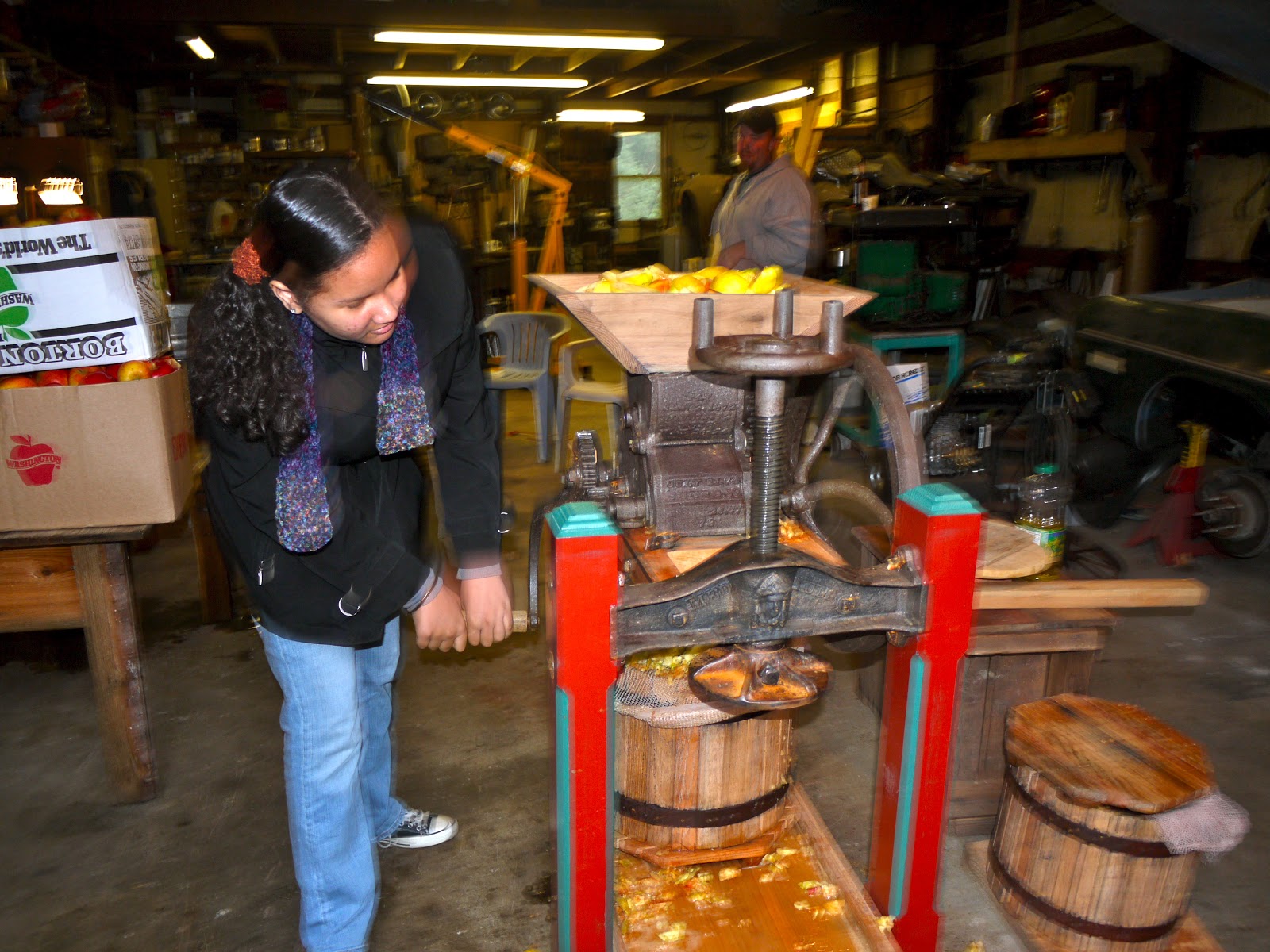
    Hank’s Grandpa Huckins’s cider press received its patent in 1872. It was well-used for generations. Finally the wooden parts rotted away. When Don Frick found it a few years ago, it was just a pile of cast-iron pieces. This gifted jack-of-all-trades saw possibilities in the fragments, so he saved them.

    Then, while visiting the museum in the northwest Washington community of Lyndon, he saw the same type of press on display, all the pieces in place and the wooden sections in good condition. He asked permission to take photographs and measurements, then went home and replicated the missing parts. A few cast iron fittings were also missing, so he had them reproduced in brass. He cleaned and reassembled the cider press. It worked!

    Here’s how to make cider the old fashioned way:
First, pick your apples. They don't have to be perfect.
Next, wash the apples and chop into quarters.
Pour the apple pieces into the hopper.
Turn the crank to grind the apples. Repeat until the wooden barrel is full.


Center the full bucket under the press, put the template over the apples, and turn the handle to squeeze the juice from the ground fruit. (The barrel has a removable bottom. A net is place inside before the apples go in.)  

Don uses a straight-grained three x four for added leverage. The cider runs between the wooden slats of the container and through a cheese-cloth filter into the metal bucket. A second container of apple waits to become cider. The leftover pulp makes a treat for visiting deer. 
 Almost done. Now the cider goes into a stainless steel vat to be heated over a gas burner to a temperature of 172 degrees. If allowed to get too hot, the pectin in the juice will separate out, ruining the cider.
The pasturized cider goes into jugs. It will keep unfrozen for a couple of weeks, or can be frozen indefinitely.

A tall glass of chilled cider. Delicious!


Saturday, November 10, 2012

Lois Blythe, an Extraordinary Heritage of Love


An ordinary saint went home to heaven this week. Lois Larson Blythe looked like the Scandanavian she was: sturdy, strong-jawed, with busy hands and a firm will. She lived more than sixty years in the same community and was happy to be part of it. Her blue eyes could snap with humor, gentle with love, or flash a stern teacher-look that could make even a grown-up former student straighten in his seat.

The young preacher assisting at her memorial service remembered his first meeting with her. She was subbing for his regular teacher. He was five years old and had done something out of line. He felt a yank on his ear and looked up to see her looking down at him with “that” expression in her eye. She told him to mind his manners, and he obeyed immediately. But he knew she loved him.

Her husband Norman was the love of Lois’s life. When they married, she came to live on the Blythe family homestead in the Robe Valley. That’s where they raised their three children and spent most of their married life. When the valley men organized a volunteer fire department, Lois helped to organize a ladies’ auxiliary, the Robe Fire Belles and became a moving force in the fund raising activities that purchased much of the equipment needed for the fire department. She was a long-time member of the Granite Falls Christian and Missionary Alliance Church, where she was “Grandma Blythe” to the church’s children.  She was actively involved with the Granite Falls Historical Society and Granite’s beautiful new museum.

When she and Norman moved down the road to Granite Falls, Lois’s antique grand piano went along. She loved to sing and play the piano, and played for anyone who asked. She kept fresh-baked cookies on hand for the children and adults who stopped by to visit. She listened with her whole self, but when she spoke, people paid attention. Her nine grandchildren, always her pride and joy, knew Grandma was no one to fool with.

She planned her own memorial service, picking joyous, triumphant scripture passages and songs that beautifully expressed the faith she lived by. As she said of herself in her obituary, “Granite Falls is where she lived and heaven is now her home.” Lois Blythe might have been an ordinary type of saint, but she left an extraordinary heritage of love for others.


 Click for more about Lois's piano: 

Tuesday, October 30, 2012

Thrills and Chills

A story from A Logger's Daughter: Growing Up in Washington's Woods

    With four younger siblings, I sometimes had to postpone normal childish milestones because the others were too little...like trick-or-treating at Halloween.

    But sometimes friend and neighbor Marcella took me with her on big-kid adventures, such as my first trick-or-treat expedition the October I turned six. Robe Valley neighbors Norman Blythe and his brother Bob went also, along with Betty and Margaret Otto, all of them twelve to fourteen years old. The five older kids  stopped at my house at dusk. I walked with them to where the road intersected with the old gravel lane that had been the first route into the valley. We followed the overgrown lane until we came to the collapsed ruins of an old cabin with a rusted-out car body in front of it. The boys told scary ghost stories about the place, but Marcella squeezed my hand to let me know they were making it up. They tied string at knee level between trees on opposite sides of the lane to snag anybody else that might come that way.

   By the time we got back to the main road, the stars were out. I trotted along with the big kids as they sang “Red Sails in the Sunset” and other popular songs of the day. I didn’t know those songs, but I did know “The Bear Went over the Mountain.” As soon as they stopped to catch their breaths, I belted out my song at the top of my lungs. They laughed at me, but Marcella joined in and then the rest did, too.

    We asked for treats at the neighbors’ homes, and they gave us home-made cookies or apples. I especially remember visiting Green Gables, a new store then, whose proprietor sold gas and a few groceries. He opened the door to our knock and, thrill of thrills, gave us each a candy bar from his glass-fronted case. Sadly, Green Gables closed this summer after seventy-five years in operation.

    We also stopped at the shack where a man we called Eaglebeak McQuarry lived. I clung tightly to Marcella’s hand because I was afraid of the lanky-haired man with sallow skin and grimy clothes. He looked dark and dull all over except for the scary glint in his black eyes. To my relief the shack seemed deserted. We found later that he and his silent Indian wife had moved away without telling anybody. The boys soaped the windows but stopped when we heard the whine of a dog coming from inside. We backed away and ran down the dark highway until we neared my home. The older ones dropped me off with my loot.

    I couldn’t keep a secret. I told my parents what had happened at the shack. The next morning my father released the abandoned dog.

    For me, the chills of that Halloween almost equalled the thrills. It was certainly my most memorable!

Tuesday, October 23, 2012

Harvest Time in the Deltas

A windstorm downed this corn


Farmers in the Skagit and Stillaguamish deltas have faced challenges like farmers all across the U.S.A. this year. Heavy rains lasting until almost the 4th of July delayed plowing and planting. Then came drought, the worst in 50 years in the U.S. and also in Southern Europe, Russia, China, and the Ukraine.


We wondered if the corn would grow in time to ripen before the winter rains. Well, much of it did, green and high above a man’s head. But some dried up before it reached full height, stressed by the dry weather. Then, before the harvesters got into the fields, a windstorm flattened whole fields of the best-looking corn. Was it too late to salvage it for the silage the farmers need to feed their cattle another year?

Perhaps not. Several days after the storm, we noticed harvesters working in the corn fields below our home. We grabbed the camera and drove down to watch from the edge of the field.

Cutting and chopping downed corn; blowing it into the hopper
Hoisting the load into the truck
Off to the storage silo

A Stillaguamish Valley farm with pit silo and silage
We followed a truck full of chopped cornstalks. It stopped at a scale to be weighed, then drove out into the country to deliver its load to a farmer’s pit silo. A pit silo can be an area walled on two sides. The corn is piled between the walls, and the farmer packs it down by driving a tractor over it. When the pile is large enough, and compacted well enough, it is covered with plastic weighted down with old tires. Then it ferments until the farmer needs silage to feed his dairy cows. Sometimes the corn is simply piled in a mountain on the ground, compacted, and covered.

I learned that drought-stressed corn can make high quality silage if harvested, packed, and stored carefully. As with most endeavors, there’s a lot more to all that than meets the eye. But even if we don’t understand all that we see, it’s fascinating to watch the harvest going on.


Monday, October 8, 2012

Fifty Years Ago This Month


Damage from the Columbus Day Storm, Oct. 12, 1962

In October 1962, fifty years ago, my first husband, Bob Biggar, and I had been married only six months. After spending the summer in Alaska, we’d just settled in to new jobs and a new home near Marysville. It was a memorable October for two other things as well: the great Columbus Day windstorm of 1962 and the Cuban missile crisis.

    On the afternoon of October twelfth, a friend, Ruth Anderson, was being married at  the Granite Falls Christian and Missionary Alliance church. Sister Patty stood with Ruth as her maid of honor. Bob taped the ceremony on our reel-to-reel Ampex stereo.

    As the pianist played the recessional and the wedding party formed the receiving line, the electricity went off. Despite the rising wind outside, the reception went on by candlelight.

My parents had driven down to the wedding from the Robe Valley. They told us that sister Lois and her husband Jim were there, visiting from Tacoma where they both taught school. Bob and I hadn’t seen them yet, so despite the wild weather, we followed Mom and Dad home to the valley. We found later that we were in the midst of an unexpected typhoon which had originated off the coast of Oregon. It had reached us just in time for the wedding. Many trees were falling, stranding wedding guests in Granite Falls. As we crept east along the Mountain Loop Highway, we feared at any moment we’d be stranded too, or worse, struck by a falling tree. Dodging trees dangling over a road carpeted with slippery dead leaves and littered with branches, we finally reached Verlot.

The lights and phones were out there, too, so we visited by candlelight. The wind continued to get worse. Suddenly we heard a roar like a freight train heading straight for us. We fled to the back of the building as a blast of wind slammed my parents’ little house. In the quiet after it passed we heard trees snapping and crashing in the woods all around. A tree thumped down next to the house, tearing electrical and telephone wires from the wall outside the kitchen.  But fortunately, the large fir tree in front, big enough to flatten the whole structure, held firm.

Lois and I were frantic because Bob and Jimmy had taken our Jeep out for a spin, storm or no storm. Moments later they drove in, shaken. They’d narrowly missed a falling tree and had to maneuver the vehicle over it.

The next day we learned that a tornado had hit the Blythe brothers’ neighboring farms, just around the bend. It damaged all of Fred Blythe’s buildings. Will’s old prune tree was twisted off and blown fifty feet away. His water tower and tool shed were demolished too. In the memory of the old timers, nothing like that had every happened before. And there’s not been a storm like it since.

When the wind quieted, Bob and I set out for home but had gone only a couple of miles when we came to a big tree blocking the road.  Some young men with a saw cut away enough of it for our Jeep to squeeze through, then we drove home, dodging downed trees and power lines.  Just west of Granite Falls, debris and tangled trees and lines nearly hid the surface of the road.

We found our place relatively unhurt. The storm had splintered some of the maples. Wind roaring down the chimney had coated everything in the house with soot and ashes. But the next day dawned blue and beautiful. All the neighbors came outside to clean up the mess. Strangest of all were the leaves. All that still clung to the maples and alders looked as if they’d been ripped and shredded by an armada of ravenous insects.

The next week brought the Cuban missile crisis. The United States came as close to the brink of war as it had since the cold war with Russia began. People listened, shocked, to President Kennedy’s speech in which he told the nation of Russia’s secretive building of missile bases in our own back yard, despite Nikita Kruschev’s promise not to put nuclear weapons in Cuba. He said the U.S. had set up a blockade to stop and search all ships coming to Cuba. Many citizens feared that bold step could trigger nuclear war.

Like young couples of any era, all we wanted was the chance to make a good life with each other. We wondered if we’d get that chance.
Nikita Kruschev, John F. Kennedy (Photo in Public Domain)

Most of us didn’t know it then, but America’s military pilots, risking their lives in dangerous low-level flights over Cuba, had shown Kennedy photographic proof of missiles aimed at the United States and the nuclear warheads that could make them ready to fire in a matter of days. They gave enough warning to enable our President to play his hand and force Kruschev to back down. World War III was averted, and we did get our chance to build a good life for ourselves and our children.


Saturday, October 6, 2012

Drama in the Blueberry Patch


Young Blueberry Plants Under Netting
My son Rob and his family live in the Skagit Valley on a former farm. They have fruit trees, grapes, raspberries, and a wonderfully productive patch of sixty-year old blueberry bushes. With all this bounty ripe for the snatching, their farm is a great attraction for the many kinds of birds that call the Skagit home. That’s why the blueberry bushes are sheltered by fine black netting, like in the photo above. But Rob’s bushes are so large they touch the netting. That means robins and starlings can perch on top of some bushes and pluck the berries right through the netting.

That led to one of nature’s dramas recently. A robin must have caught a foot in the netting. His struggle attracted the attention of one of the abundant raptors that cruise the farm fields surrounding Mt. Vernon...a peregrine falcon. These falcons have long been trained to the hunt in the ancient sport of falconry. Females are larger than the males, with a wingspan of three feet or more. Falcons prey on medium-sized birds, often catching them in mid-air following a spectacular dive, or “stoop.” Their dive speeds of more than 200 miles per hour make the peregrine falcon the world’s fastest living creature. Such an impact is devastating to the prey. In this case, it nearly caused disaster to the bird of prey, as well.

    When the falcon hit the robin, she also became entangled in the net. Rob walked by in time to notice what had happened. By then, the bird had pulled the netting to the ground, but it had wrapped several times around one leg. She was trapped.

    Armed with a stick to prevent the falcon’s sharp beak from snapping shut on his hands and his jackknife to cut the net, Rob approached the struggling bird.

“Nice bird. Are you going to let me help you? Don’t bite me. Just sit still and I’ll cut the net away.” Rob kept up his gentle talking while slowly unwrapping the tangled netting. The bird snapped a time or two, then seemed to realize that help had come. She stopped struggling and watched. Finally he cut through the layers. The falcon screeched and flew to the nearby cherry tree, where she tugged at the bits of cord still wrapped around her leg. Rob could see that she’d be able to get it all off, but she didn’t wait to finish the job. With a last look at her benefactor, she soared off to the safety of the open fields.

Peregrine Falcon at Lunch
    It was then that Rob found the robin, killed instantly by the power of the peregrine falcon’s blow. He rolled up the netting so the birds could harvest the rest of the crop unimperiled by man-made hazards.

Monday, September 24, 2012

Once Upon a Time in the North Cascades


North Cascades Visitor Center
Has your curiosity been piqued, like ours, by a roadside trail or sign inviting you to stop and investigate? Hank and I had driven the North Cascades Highway, through the North Cascades National Park, many times. Near the Seattle City Light company town of Newhalem, we always noticed a narrow road leading into the woods with a sign pointing to "North Cascades Visitor Center." We wondered what might be there and finally took time to check it out.

We were surprised to find a one-lane bridge spanning the green Skagit River, complete with traffic light signaling when we could cross. We followed the road back to a welcoming stone-and-timber Visitor Center hidden among the trees. Inside, rangers answer questions. We wandered through a beautifully designed multi-media center with displays and videos about the park’s wildlife, plants, geology, and early inhabitants. The North Cascades National Park is one of our more lightly used parks, a real treasure that deserves to be much more widely known. The Center here and the displays at nearby Newhalem are good places to start.


We checked out a map of nearby walking trails. One, only 300 feet in length, followed a boardwalk behind the Center to a spectacular view of clouds lifting over the Pickett Range.

The Pickett Range
Part of the rock shelter


We took time for another short walk, this one also wheelchair accessible although steeper. The Rock Shelter Trail starts just past a bridge over Newhalem Creek, near where it empties into the Skagit, and climbs a mossy hillside to another boardwalk, which also leads to an overlook. It looks down on an area the Upper Skagit Indians called “Duwaylib,” or "goat snare." Later comers wrote it down as “Newhalem.” People hunted mountain goats nearby, then camped beneath the huge overhanging boulders to cook the meat and process the wool. They also
caught salmon migrating upstream to spawn and dried them beside Newhalem Creek.

Archaeologists carbon dated mountain goat bones and other artifacts found in the rock shelter to 1400 years ago. They found rock chips and broken points left from tool making. Traces of campfire smoke can still be seen on the rock ceiling.
 
Newhalem Creek


The photos don’t give a true picture of the scale of the scene. Thick blankets of moss hide traces of the old trails. Trees grow up, break off, rot back into the forest floor. Frost pries chunks of rock from the overhangs to litter the floor of former campsites. Still, one can call his or her imagination into play and people this quiet place with women cooking over a campfire, children playing along the edge of the creek, hunters coming down a trail carrying their trophies on their shoulders.

Native Americans climbed to the high mountain valleys every summer to pick berries, dig roots, and hunt. It gives us pause to think that where cars and trucks now whiz over  paved highways from one side of the mountains to the other, trading parties from both east and west once labored over the passes on foot to bargain for goods they could not find at home.

What else waits to be discovered in beautiful North Cascades National Park?