Followers

Thursday, February 2, 2012

God at Work in the Rocks


Rocks of the Texas Canyon formation

Rocks show spalling caused by freezing and thawing

Rocks. Mountain size, or miniaturized to a grain of sand, they’re everywhere. Especially here in the American Southwest, where there’s not much soil or plant life to hide them from view.

Recently, we pulled off Interstate 10 into Arizona’s Texas Canyon, in search of the private, non-profit Amerind Foundation museum. We found ourselves near an upthrust range of mountains intriguingly named the Dragoons. (A dragoon was a calvary soldier outfitted with the heavier armaments of a foot soldier.) It was to the vertical labyrinths of the Dragoon Mountains that the Apache warrior Cochise fled from the Confederate calvary that eventually defeated him.

But it was the nearer rocks that caught our attention. Stacked, balanced, and weirdly-sculptured, they looked like the abandoned playthings of some colossal child. What caused them to look like that?

In the museum, we found a brochure that gave the answer.

The formations in these photographs are part of a body of igneous rock called Texas Canyon quartz monzonite. It’s a granite, and it looks as it does because it was once magma (molten rock) that rose slowly without reaching the surface. It cooled beneath the earth’s crust, forming large crystals of the potassium-rich mineral, feldspar. Between the large crystals, other minerals crystalized: quartz, biotite, and plagioclase. Once the rocks that covered the blocks of quartz monzonite eroded away, they were exposed to natural weathering processes that rounded them at exposed surfaces and along the joints.

Tiny cracks formed between the larger crystals, allowing water and oxygen to invade and weaken the granite, prying the mineral grains apart. Sheets of rock spall off the outer surfaces of boulders along curved cracks or joints when water invades the spaces, then freezes. This helps round the blocks. As the rock around the boulders of quartz monzonite disintegrate, the pedestals, spires, and balanced boulders that form the Texas Canyon outcrop appear.

What a reminder of our creative God at work!

Only 40 miles to the east of Texas Canyon, a similar magma intrusion reached all the way to the earth’s surface. It caused a gigantic eruption that spread a thick deposit of lava and ash and left a tremendous crater. Today, in Chiricahua National Monument, one sees oddly-shaped columns and spires, the remnants of that almost 27 million year old ash blanket. The difference between one landscape and the other is all in how the rock reached the surface. 


Chiricahua National Monument, Photo courtesy of National Park Service

Texas Canyon quartz monzonite formations


Wednesday, February 1, 2012

A Love Affair with Arizona

A desert sunrise
In the Saguaro National Monument


When I was young, the gorgeous desert and canyon photographs in Arizona Highways magazine enticed me. I was also fascinated by the lovely art of the indigenous peoples of the desert. If only I could leave behind the drab, wet Northwest winters to experience for myself the light and warmth of exotic Arizona!

God loves to give his children the desires of their hearts. When we’re young, we may find that hard to believe. Sometimes we want things badly. Not getting them leads to disappointment. We don’t realize that what we want may be bad for us, or that we must learn to wait for what we want.  Sometimes, getting what we think we want turns into disillusionment.  But often, God delights us by eventually giving us what we desire, and more.

An opportunity to fulfill my desert wish came after I had graduated from college and taught school for four years in Washington State. I sent resumes to various Southwest cities, eager to experience life in the land I dreamed about. My sister and I set out for Arizona, stopping for an interview in California. There I learned that, due to a misunderstanding, I had not been released from my previous job.

Major disappointment!  We turned around and drove back to Washington, never even seeing Arizona, and I went back to my former position. A few weeks after school started, I met Bob Biggar, a young man from Alaska. Six months later, we married. We moved to Alaska. I’d never thought of living there, but I loved it. While we raised our family, I started a writing career, and we made lifelong friends. (More heart’s desires fulfilled!)

When my husband’s health began to fail, doctors told him he needed a warmer climate. We returned to Washington, and one winter we decided to take our travel trailer to Arizona. We enjoyed a month of exploring fascinating places while I did research for a young adult book set in Arizona. Then our insurance company cancelled our auto coverage. The only way to resolve the problem was to return to Washington. I did finish my research, though I still wanted to experience more of the Grand Canyon State.

A while later, Bob died. After six years, I married Hank (a good gift from God which is another story.) My daughter, Lenora, received her heart’s desire when she married Steve.  Then she and Steve moved from Seattle to live in Arizona year-round.

I missed Lenora terribly, but now we had an excuse to travel to Arizona every winter. This year we’ve rented a vacation apartment, and we’re staying a month. I’ve come to realize through my daughter’s experience that I’m wimpy about hot weather. I really don’t want to live here year around. But God has given me the chance to enjoy the desert and its denizens up close and personal during the best time of year, and also to spend time with loved ones. All because God knows our heart's desires and he loves to fulfill them.

Lenora, Steve and Bella with Hank, after an evening walk in the desert

Monday, January 23, 2012

Somewhere the Sun is Shining. . .

Shore crab defending his crevice in the rocks
 At home in Washington, the snowstorm moved on, leaving rain, rain, rain it its wake. San Diego also had rain, but yesterday the sun came out. Low tides drew crowds of people to the tide pools at Cabrillo National Monument at Point Loma, and we went, too.

Cormorants and pelicans


Tide Pools and eroded sandstone cliffs at Point Loma


Fascination for all ages
Up close and personal

Enjoying the sunshine at the Point Loma tide pools


Friday, January 13, 2012

Snowy Owls Come to Stanwood

    This has been one of those unpredictable winters with no snow, not much rain,  and occasional glorious sun breaks that make us feel lucky just to be alive.

    Late one sunny afternoon this week, Hank came upstairs from his windowless office and said, “Let’s go up in the mountains to enjoy the sunshine.”

    I glanced at the clock. “When we get there, it will be dark. Why don’t we go someplace close and look for birds?”

    We grabbed our coats and the camera and headed toward Camano Island. By the time we reached the new Mark Clark Bridge a few miles from our home, the sun was already dipping toward the island. At the end of the bridge, Hank swung left onto Eide Road. We’d passed this spot hundreds of times but never ventured down to Leque Island, which lies between Port Susan and Skagit Bays.

    The Eide family farmed there for nearly a century. Prior to settlement, the island had been entirely salt marsh. It now consists of wetlands and diked fields where contract farmers plant grain every year as food for wintering waterfowl. About 100 acres of Leque Island’s 325 acres is being restored to an intertidal estuary. This will provide habitat for juvenile salmon and also benefit other fish and wildlife.

 We passed the bare spot where the Eide house had stood and continued beside the dike to a small parking area.  Almost immediately we spotted a juvenile eagle in a gnarled old cottonwood that once shaded the homestead. Birds flitted from branch to branch in smaller trees that may once have been an orchard.

     Already the light was fading. We were out of sight of the highway. The dike hid the river and the town beyond. In the stillness, we heard the gabbling of snow geese. Soon loose skeins of hundreds of birds passed overhead, hurrying toward the tide flats to spend the night.

     Rounding a bend in the road, we met a couple of men walking back to their vehicle. From the looks of their equipment, they were serious birdwatchers. They told us they’d seen a snowy owl. Our ears perked up. Snowy owls belong in northern Canada and Alaska. But this winter many are being spotted in our area and across the United States, some as far south as Kansas.

    Ahead of us, huge bags of sand backed a wall of concrete blocks where storms, combined with high tides, had washed away the dike. A small, energetic woman with binoculars, camera, and a big spotting scope had established herself atop the barrier. We learned she’s a research ecologist, but she and her dog often come to this spot at sunset or early morning to watch the birds. (The dog was more interested in getting us to toss his ball than he was in the birds.)

    She pointed out the dark female northern harriers and the smaller, lighter males swooping over the field, hunting for voles. Short-eared owls made soundless sorties of their own. Our new acquaintance offered to move her scope to an easier-to-reach spot on the dike, so we could see the snowy owl she’d been watching.

    She focused the instrument and let us peer through it. Sure enough, far across the river we could see the fluffy, pale form of a female snowy owl sitting on a stump. Snowies are among the largest of the owls, with wingspans that can reach almost five feet. Since they’re native to the tundra, they seldom perch in trees but rest on driftwood or fence posts instead. They live on lemmings and other small mammals in the Arctic, but when the lemming population crashes or when there’s a bumper crop of juvenile owls, some are forced further south. That’s why happy birders in our area are getting a look at this sudden population increase, or irruption, of snowy owls.

    We thanked our new  friend for showing us the rare visitor and walked back through the twilight to our car. Harriers and owls still ghosted low over the abandoned fields of Eide’s farm. Who knew what adventure waited when we dropped everything to answer the call of a sun break and the out-of-doors?


Photo courtesy of: http://animal-wallpaper-free.blogspot.com/2010/04/best-snowy-owl-pictures.html


Tuesday, December 27, 2011

The Spirit of Generosity

    This Christmas will go down in my personal history book as “the best ever.” Not because of the gifts, or the way-too-abundant holiday treats, or the decorations. Not because of the Christmas concerts and other celebrations, or the cards and letters reminding us that we’re important to the far-flung people we love.

    What made it “best ever” was the spirit of generosity that touched us in many ways.

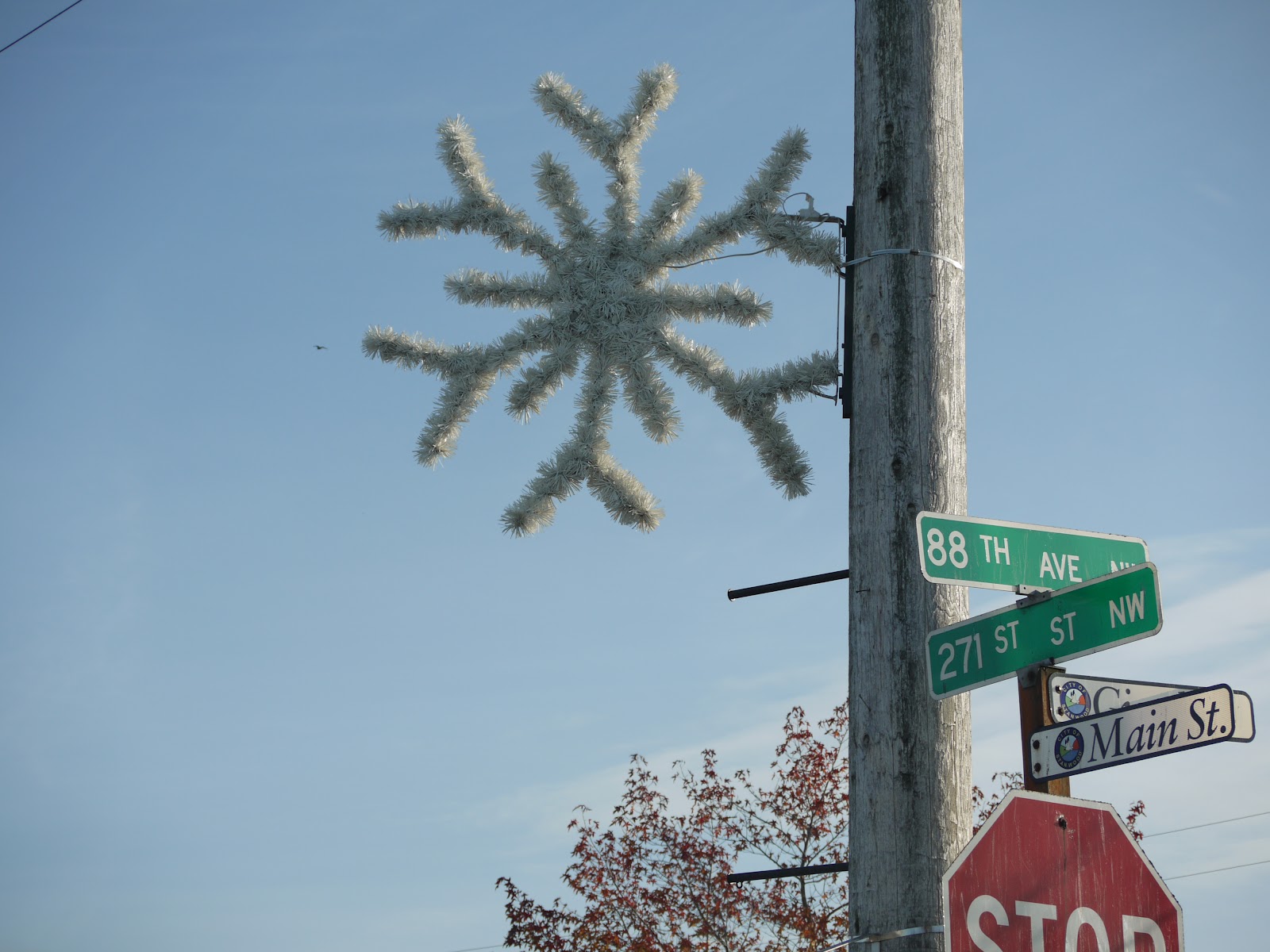
    Every year, somebody hangs giant snowflakes and lighted wreaths along our town’s main street. While out walking the morning after Thanksgiving, we caught them in the act. Stanwood Lions Club volunteers were partnering with a TV cable company to put up snowflakes that sparkled in the fog. The man in charge told us the Lions also hoist the lighted Christmas tree to the top of Stanwood’s icon, the old Hamilton Lumber Mill smokestack, as well as install other symbols for later holidays.

    Another day, we joined a number of senior citizens at Stanwood’s Community and Senior Center for Christmas luncheon. We were all delighted when one hundred fifty children from nearby Cedarhome Elementary School filed in to entertain us with a varied and enthusiastic program of holiday music, some of it original compositions from their teacher, Mr. Rich Crouch. Thanks kids and teacher, for sharing your talent!
Dennis Bunch on his Honda 1300cc

    When we drove to Camano Island to finish our Christmas shopping, we were amused to see Santa Claus sitting by the highway, waving from a bright red Honda motorcycle. We stopped to talk with him and take his picture. Santa (Dennis Bunch) has been sitting on that motorcycle for several hours a day, every Christmas season for six years, because he feels its a way he can bless others.

    Volunteers around Stanwood come by ones, by a few, or by the hundreds. The Warm Beach Lights of Christmas, only four miles from town, is known all over the country for its more than one million lights and its family-friendly activities that go on for twenty nights in December. More than 800 volunteers band together to set up the displays, man the events, and later take it all down again. They make this a happy, well-loved destination for young and old.

    For us, what made this Christmas truly “the best ever” was a generous gesture from one of our sons. His sister lives in the Arizona desert. She’s homesick for the damp green Pacific Northwest at Christmas time and we miss her, too. His gift to all of us was to fly her home for a weekend packed with love and fun.

    What better way to celebrate the birth of One who gave the best gift ever than to imitate his giving spirit? That spirit of generosity is the thread that ties the whole package together.

Tuesday, November 29, 2011

John Aaron Rawlins, a Man for His Time


Brigadier General John A. Rawlins, Chief of Staff,
at City Point, VA, with wife and child at door of their quarters


Before the American Revolution, three brothers named Rawlins came to settle in the colonies from England. At Sun Breaks, http//rainsongpress.blogspot.com,  the entry for August 28, 2011 begins a three-part story about one of them, ancestor James Mason Rawlins, who was willing to give up his family and perhaps his life for what he thought was right.

James Mason Rawlins was born around 1737. Soon after, in 1742, another Rawlins boy named James entered the world. He was James Rawlins III, born to Sarah and James Rawlins II. James Rawlins III became the great-grandfather of John Aaron Rawlins, the subject of this story. By 1826, both John’s family and descendants of James Mason Rawlins were living in Illinois.

Despite a crash course in beginning genealogy, I haven’t yet discovered how or if John Aaron Rawlins is related to our branch of the Rawlins family. But since one purpose in telling these tales is to show how our family (and all American families) help make up the larger history of these United States, here is the story of Major General John Aaron Rawlins. 


    John Aaron Rawlins was born in Galena, Illinois on February 13, 1831, one of eight siblings in a family of very modest means. He helped to support the family by hauling the charcoal made by his father to nearby towns and selling it. When his father left to join the 1849 California gold rush, John looked after his mother and siblings. He loved his father deeply but hated his bad habits. Because of his father’s drinking, John vowed never to touch strong drink. One writer thinks it was this aversion, as much as anything else, that became the basis for his place in history.

    John was an intelligent, darkly handsome young man with an unusual gift for oratory. His early education was spotty, but at the age of twenty he entered secondary school with the goal of becoming an attorney. He was admitted to the Illinois bar in 1855 and practiced law in his hometown. By 1858 he’d become interested in politics. Though a staunch Democrat, according to writer Lee Bonnet, he made speeches on behalf of fellow Illinois resident, Republican Abraham Lincoln, in the 1860 presidential campaign.¹

    Then the Civil War broke out. After the first Battle of Bull Run as the fighting moved closer to home, Rawlins organized a band of civilians into the 45th Illinois Volunteers, inspiring the new soldiers with his rousing speeches.

    The town of Galena was intensely loyal to the Northern cause. More generals called Galena home than any other Union city. The town probably contributed more privates, as well. One night local Republicans staged a big political meeting. Rawlins was advised that they would not welcome him as a Democrat, but he insisted he was going, and if asked to speak, he would not remain silent. Wherever he went, he was usually asked to speak, and it happened again that night.

    One of those attending the meeting was a modest, rather inarticulate colonel named Ulysses S. Grant. He had been a clerk in his father’s leather-goods store and knew Rawlins slightly because Rawlins had done legal work for the company.

    When the audience called “Rawlins! Rawlins!” John responded. He made what one author called “one of the great speeches of the Civil War period: a speech which rallied everyone, regardless of party, regardless of previous views about slavery and about sectionalism, regardless of anything and everything. He appealed to the God of battles to aid the great cause of the North; he appealed to everyone to give his utmost.”²

    Grant was among those who wanted to give his utmost. He asked Rawlins to join him as assistant in his military ventures, and as Grant advanced up the ranks to general, so did Rawlins. Eventually Grant made him his chief of staff.
   
    One of John Aaron Rawlins’ outstanding characteristics was his loyalty. He’d been fiercely faithful to his wife, Emily, with whom he had three children, and remained at her side, comforting her until her death in August 1861 of tuberculosis, a major killer of that day. Though in deep sorrow, he joined Grant to become one of his most trusted confidantes, deeply involved in every decision and every battle. He organized Grant’s military camp and also worked to protect Grant from the demon of strong drink.
   
    According to historian Elmer Gortz, Rawlins did have an interesting flaw or ability, depending upon one’s perspective. When the occasion warranted, he could erupt into the most passionate, evocative, eloquent surge of swearing imaginable. One of the people who witnessed his colorful language was a northern girl named Emma Hurlbut.

     Emma was working in Vicksburg, Mississippi, as a governess during the siege of the city. Rawlins was assigned to protect her from the unwanted attentions of soldiers and officers. Not only did he do his job well, he also courted and married her. Emma was able to curb his profanity.

    John Rawlins had become a Major General by the time the war ended in 1865. He returned to his law practice in Galena. By then, he’d also contracted tuberculosis.

    In the summer of 1867, General Grant urged his chief of staff to go out West, hoping that the climate might help him recover. Accompanied by an aide and several friends, Rawlins traveled to Cheyenne, Wyoming. There he met General Grenville M. Dodge and a party of civil engineers who were surveying a railroad route westward from Omaha.
   
    As the company rode west on their horses, approaching the hills near the present city of Rawlins, Wyoming, the ailing general expressed a desire for a drink of good, cold water. Scouts set out to explore. They discovered a fine spring of water near the base of the hills and brought some back to the sick man. General Rawlins declared he’d never tasted a drink more refreshing. “If anything is ever named after me, I hope it will be a spring of water,” he said. General Dodge heard what he said and immediately named it “Rawlins Spring.”

    The town that grew up near the spring, a division point of the railroad, was at first called “Rawlins Spring.” Later, the name was shortened to “Rawlins.”

    Unfortunately, the expedition did not improve Rawlins’ health. He returned to the East, and a short time later Ulysses S. Grant became President Grant. The president summoned his old friend Rawlins to Washington, D.C., and in March 1869, made him secretary of war.

    John Aaron Rawlins died five months later at the age of thirty eight, on September 6, 1869. He is buried in Arlington National Cemetery.


¹ http://www.imrubicon.com/general.htm (Lee Bonnet)

² from Three Galena Generals, by Elmer Gortz, 1955 (Speech to Illinois Historical Society)

Tuesday, November 8, 2011

Giving the Gift of Heritage

GIVING THE GIFT OF HERITAGE

    Sharing Your Stories
   
    Guest Blogger, Sharon Brilla

Something in our hearts responds to story. Before the invention of radio and TV, before we even had access to the written word, stories were the way we passed on our history and our culture. We especially love tales of courage and triumph over difficult circumstances. Stories about family help us know where we fit in the scheme of things. What small child doesn’t beg, “Tell me a story?”
   
Sharon Brilla, Co-Director of Social Services at Josephine Sunset Home here in Stanwood, says:
“One of the greatest gifts we can give to our families is sharing our trials and failures and how we overcame in the midst of turmoil.” She relates this to the Biblical account of Moses leading the Israelites out of their Egyptian captivity to the land God had promised them. Moses told the people, “‘Teach what you’ve seen and heard to your children and grandchildren.’ As we face tough economic times we can help the current generation learn to face adversity and remind them we can be over comers.

“My mother told about putting cardboard in her shoes because she couldn’t afford another pair of shoes. All of us have Exodus stories about how our family has survived when life happens. Our challenge is to share our stories with the next generation and teach them to recognize their own stories.

Christmas time is a perfect opportunity to remind our families of our triumphs and lessons learned from the hard times. This year give the gift of legacy and start a new family tradition.”
   
Here are some of Sharon’s ideas:

* Start a journal with stories from the past and add new stories throughout the year

* Play a game of remembering past victories. ‘I remember the time Grandpa’s car broke down on the  freeway and….’


* Start a prayer journal with your family. Record answers to your prayers.


* Share a time when you failed and what you learned from the failure.

* Encourage younger family members to share their Exodus stories. This year I will remind my grandson of his fears on the first day of school. That morning he asked me to pray, and when school was out, he said, ‘I had a good day, Grandma.’


Here are a few ideas from Sun Breaks:

* When you put your photos in albums, or download them to your computer, be sure to label them with the occasion, place, and people in them. Don’t let your treasured photos end up in a shoe box in some estate sale because no one knows their significance.

* Keep a journal, if only jottings on a calendar to keep track of important daily happenings.

* Keep scrapbooks of family events.