Followers

Friday, July 23, 2010

A Different Kind of Vacation

At Owl Hoot Camp near Lac la Biche
l. to r. Adam (family friend); Troy & Clarissa Austin, Allen Shaw, Katrina Shaw and Aaron, William Shaw, Hank Husby, Vicki Shaw, Joan Husby

    For years my Canadian cousins, the Shaw family, have told us about their annual camping trips to Lac la Biche (Lake of the Fawn). This year Vickie e-mailed, saying “I know it’s short notice, but we have room for two more. Would you like to go along?”

     Would we? Yes, indeed! We dropped everything and drove 750 miles north to Innisfail, Alberta. There we joined Vickie and Allen, their young-adult children, Clarissa, William, and Katrina, plus Clarissa’s husband Troy, and Aaron, Katrina’s boy friend. They’re a lively crew who really enjoy having fun together.

    Among her many other talents, Vickie is a gifted organizer. She and the kids had prepared and packed five days’ worth of meals. We all helped load utensils, towels, games, fishing equipment, cameras, lifejackets, tools–well, everything needed to sustain the group for five days. Allan towed a boat, also loaded to the gunnels with supplies.

    We drove five hours north and east to reach our destination, an old fishing resort on the placid Owl River. The Shaws discovered the place years ago, when my Uncle Bill, Vickie’s father, visited them and expressed a desire to go fishing. It’s a beloved spot for all of them. The owner of the camp passed away last year, and his family is trying to keep it operating. Official rules no longer allow fishermen to catch walleyed pike in the Owl River. On the lake, only one northern pike per day is allowed. So fewer people come now. We were the only guests until the weekend.

    One of the red-painted log buildings is over one hundred years old. Campers boil the river water for non-drinking needs, and each cabin has an outhouse.  Only the trailer cabin, where Hank and I slept, has a bathroom. We all took turns using that shower. Aaron and William each set up his own tent, and we congregated in the largest cabin to eat and play games.

    Our boat held four fishermen at a time for the mile-long ride down the Owl River to Lac la Biche, one of Alberta’s larger lakes. Occasional farms dot the tree-lined shores. The shallow water, murky with algae and weed patches, is ideal pike habitat. Hank came back from his first expedition one happy man. He’d caught a 36-inch pike. Allan fried fish steaks for the next morning’s breakfast. Delicious, not fishy at all.
    
A peaceful moment on one of our walks
    Our days were long and lazy. That far north in mid-July the sun didn’t set until 10:30. Hank and I started each day with a leisurely walk. Sometimes we sauntered along the road where cattle congregated within sight of the bridge over the Owl River, sometimes on lanes that led through birch and spruce woods. Once a doe and fawn bounded away through a clearing. Another time we held our breaths while a buck and doe picked their way along the edge of the woods to cross the lane ahead of us. Mornings were enchanted times, with no human-made sounds, just the music of warblers and rose-breasted grosbeaks and mourning doves, punctuated by the drum-knockings of woodpeckers. Sometimes, when the rustling cottonwoods stilled, we heard a distant cow bawling for her calf.     When we weren’t fishing, we piled into vehicles to revisit the Shaws’ favorite spots, like a nearby lake where cormorants and pelicans had built their nests in condos one above the other in every tree on one small island. All that activity eventually killed the trees, and when we stood on the shore, we could see that not even one tree remained standing. Only a few of the birds circled the former rookery.
   
    Always before, our vacations have been “on-the-go” affairs, leaving us feeling as if we’ve covered too many miles, tried to see too many people and tried to do too many things. This camping trip was a leisurely adventure we never expected.

    The best part was having time to appreciate the other members of our party for the special people they are. I’ll tell more in future blogposts, but for now, I’m convinced: it’s never too late to try a different way of doing things. 
Allen checking out the boat at the Owl River launching site

Hank with the first two pike caught

Sunday, July 4, 2010

About Nest Eggs

A Hen With a Secret

Photo courtesy of Tom Curtis
http://www.freedigitalphotos.net/images


  “What’s a nest egg?” Ask some young people that question and chances are they can’t say for sure. They may think it has something to do with saving for the future, but unless they’ve raised chickens, they may not make the connection between nests, eggs, and money.

    In the days when most households kept chickens for eggs and meat, chickens often were “free range.” If the lady of the house wanted her hens to nest in the hen house, she had to have a strategy. Otherwise her hens would hide their eggs outdoors, where the eggs or newly-hatched chicks were easy marks for predators.

    Most keepers of chickens owned a few porcelain or painted wood facsimiles of hen’s eggs. To entice a hen to begin laying in the nesting box prepared for her, the farm wife placed one of the “nest eggs” in the straw. The broody hen, being easily fooled, would assume she’d already laid an egg there. So she’d lay another, and the next day another, until she had enough for a clutch of chicks. Then she began the job of sitting on the eggs to keep them warm, turning them frequently, until the babies developed and hatched.

    Humans need persuasive strategies to do the wise thing too. Hence the “nest egg,” a little money in the bank that can be added to until the savings grow big enough for the desired purpose.

Wednesday, June 30, 2010

Foundations

1940--the Rawlins family and the little house on its cedar slab foundations,  just before David was born.


   During the Great Depression, my father built a little house in the Robe Valley for his family. His total cash outlay? Less than $50 for the house and $100 for two-and-a- half acres of land.

    He salvaged timber from an abandoned lumber mill for the stringers and other timbers used in the house. Since he had no cement blocks, he cut slabs from a cedar log to make the foundation for the 18 by 24 foot house. He placed four slabs on each side and one in the center, then nailed cedar uprights to those. He laid stringers (timbers) across the uprights and a shiplap floor across the stringers. He built the floor several feet off the ground so the house would stay dry. The walls were shiplap covered with tarpaper, then with shakes that Dad split himself. He used salvaged windows and doors.

    That snug little house eventually became home to other families. Thirty-three years later, youngest brother David bought the house and remodeled it. One of the first things he did was to replace the cedar slabs with a cement block foundation. He was surprised that the wood had lasted as long as it had.

    About the same time Dad built our house, a neighbor just up the road built a house on a wooden foundation. I don’t know if he used cedar or not, but a creek ran through the swamp next to the house, and that plus our rainy climate quickly rotted his foundation. All during our growing-up years, the neighbors often heard him comment on how he needed to fix that foundation. But he never did, and the house sagged and rocked on its unsteady underpinnings while his wife and six children suffered frequent illness due to the damp conditions.

    A good, solid foundation is the first essential for any quality building project. The St. Vincent islanders in the Caribbean understand this. My husband Hank and some friends spent two weeks on the island helping a group who wanted to build a church. The Caribbeans had very little of this world’s goods, but they understood the basic principles of building. The Americans brought tools and cement. The islanders had already laid out the shape of their church and collected piles of rock for the foundation.

    Americans and islanders worked together digging trenches along the lines marked on the ground. They passed buckets of water hand-to-hand from the water source to the cement mixer, where men mixed water and cement. Then they passed the buckets of mortar hand-to-hand to the person down in the trench who fit stones and mortar together until the foundation rose above ground level, after which they skillfully leveled the top with more mortar.

    In this painstaking manner, the foundation took two weeks to build. Hank didn’t get to see the church rise atop it, but he knew, that though it was simple, it would be sturdy and last through the storms and torrential downpours that often sweep across the island.

    Jesus once told a story about two builders. One was wise and built his house on a rock foundation. But the foolish builder set his on sand. When the storms came, they washed the sand from beneath the foolish man’s house, and it fell with a crash. The wise man’s house withstood the storms and sheltered those within it.

    Jesus’ story is just as appropriate now as it was two thousand years ago. We still need strong moral and spiritual foundations. All around us, we see lives wrecked by bad decisions and do-it-your-own-way building methods. God gave us His Book of wisdom and the gift of common sense to establish a basis for living. We can be thankful indeed for parents or other mentors who pass on values gleaned from God’s Word and the wisdom of history.

    Does your foundation need a little work? It’s never too late to rebuild.

Friday, June 18, 2010

A Special Toy

For our 10th wedding anniversary, Hank and I spent a week wandering to some of our favorite places. We included a visit to the museum at Washougal, Washington state, on the Columbia River. Hank is working on a legacy of family history stories for his children, and that little museum contains files of information on the early families of Washougal  (where he grew up) as well as items donated by those families. We found one of Hank’s childhood toys on display there. It brought back good memories to him. Here’s his story:
                                                          As a young boy, I loved to follow my Grandpa Huckins and his son, my Uncle Joe, around. I liked to imagine myself doing whatever they were doing.

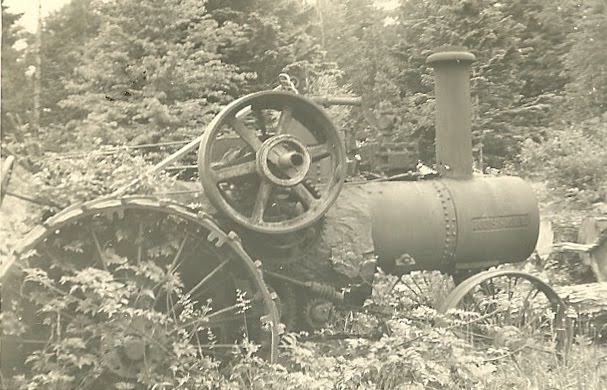
This McCormick-Deering tractor with a Russell 
boiler powered the sawmill.
Grandpa and Uncle Joe supplemented the income from their small herd of milk cows by sawing lumber from logs on the home place. Originally, a large steam tractor powered the Huckins’ sawmill. It turned a line shaft which powered two four-foot circular saws and also caused the log carriage to move forward and backward, slicing logs into rough lumber.

In about 1945 they replaced the tractor with a steam boiler and built a brick furnace beneath it to burn slabs of wood from the mill. The fire boiled the water and produced steam to power a stationary single-cylinder steam engine. As a ten-year-old boy, I was fascinated as Grandpa and Uncle Joe heated heavy steel rods in the forge and used an anvil to shape them into hooks. The hooks suspended the huge boiler from the roof timbers of the sawmill.
 
The Huckins' sawmill, with my dad in his Sunday clothes standing on a log in the log pond. 


Eager to help build the furnace, I put too much creek water in the mortar mix and Uncle Joe had to add more sand and cement to correct my mistake. For awhile, Uncle Joe’s smiling countenance clouded over, but as work progressed he returned to his usual jovial self. Imagine the smile that lit my face when Uncle Joe showed me a miniature steam engine like the one in the sawmill. It had been his toy when he was my age, and now he was giving it to me. The boiler held a pint of water. Three little burner cups fit in a drawer beneath it. He soaked cotton balls with wood alcohol and put them in the cups, then set the alcohol ablaze with a match. As it burned, it heated the water in the boiler. With the steam valve open, the steam made a whistling sound. With the valve closed, the steam drove a single cylinder which turned a large wheel, just like Grandpa and Uncle Joe’s big steam engine.

What fun! A side benefit of owning my own steam engine was a lesson in economics. Wood alcohol could only be obtained at a local drugstore at the whopping big price (in 1945) of ninety cents a pint plus three cents tax. That left barely enough of a dollar bill to buy a nickel candy bar. Since money was in short supply my steam engine seldom got fired up. Perhaps that was why it was still in working condition years later when my mother passed it on to the Washougal museum.

 
The toy steam engine

Tuesday, June 15, 2010

Old Friends


Miss Anderson's first graders, 1941                     


One September morning when I was five years old, my mother pinned my name to my sweater and sent me down the long driveway with neighbor and “big sister” Marcella to wait for the school bus. I was so excited I couldn’t stop trembling.

What a day of firsts! My first bus ride. My first day in the big brick building that would be my second home for the next seven years. My first time to sit still for long periods of time until given permission to move. My first teacher. My first time to face more than forty little people my own age, some of whom, though I didn’t yet know it, would become lifelong friends.

Kids who lived in town shared not only school experiences but also out-of-school life as well. They grew up knowing everybody in town and all their stories. Bus kids like me missed out on small-town life, but after-school activities and sleep-overs with friends helped to fill in the gaps.

Because our school was small, our class moved in lockstep through the academic offerings until high school gave us a few electives. Boys and girls took separate physical education classes. Most boys took wood shop. Most girls signed up for home economics, although the good smells of cooking brought the boys clustering around the home ec door in hopes of handouts. We all went to the after-school ball games to cheer for our team, the Tigers.

Our twelve years as classmates flew by. Of the forty or so children who began first grade together, some moved away or dropped out. Others joined us later. Twenty-four of us made it to graduation together.

Then we scattered to follow different paths...some to jobs, some to marry and start families, some to military service, some to college. Many continued the friendships forged in school, although some of us reconnected only at high school reunions.

Now we are all in our seventies. Seven or eight years ago, Nancy retired from her paying job and decided it was time to do what she’d thought about for years. She began calling classmates, suggesting that those who lived nearby get together for lunch. Since then we have met on the 2nd Thursday of every other month for lunch. Spouses come too, as well as a few friends from other classes.

Death has claimed a few of us. At classmate Dick’s funeral last year, we came as a group to say goodbye. We’ve encouraged each other through illness and loss of family members. We ask after each other’s children. We tell stories of our lives. Of course we reminisce about our shared memories.

Some classmates travel elsewhere in the winter but come back to join us in the summer. Others live far away, but occasionally return to touch base. At our last luncheon, seventeen people came.  Of those, eleven of us had started first grade together back in 1941. Sixty-nine years, and we’re still enjoying each other’s company.

Sarri Gilman was talking about Baby Boomers on Facebook in a recent column in The Herald, but what she said is worth remembering, no matter what our age: “...if you do open yourself, you will find that restoring some of these very old friends from the past can be enriching. By the time you get to 50, life has leveled the field. Everyone has had enough reality to realize we are all tender beings, and life is short.”

There’s a lot of truth in the adage, “Old friends are the best friends.”

Classmates at 55th reunion, 2009

Friday, May 28, 2010

A Sonnet to Sunny

   As Memorial Day draws near, we remember dear ones who have gone before. There's sadness at the separation, but memories of their unique qualities and their love bring great joy, as well.

 Our friend Dr. Jerry Rusher wrote this lovely poem for his wife Wanda, who went home to heaven two years ago. He and Wanda loved to hike, and the inspiration for the poem came one  morning as they watched the sun birth a rainbow in the mist of a mountain waterfall.


A Sonnet to Sunny

Dewdrops forming on the grass
Lie hidden to the watching eye,
Yet how they gleam like beads of glass,
When the sun climbs in the sky.
**
A cascade falls in shadows dim,
While a mist obscures the air
'Til rays of light come bursting in,
And lo! There shines a rainbow fair.
**
My sunny one, you're like the dew,
Or the misty waterfall,
As the Son comes shining through.
This quivering heart becomes enthralled,
To see reflected in your eyes 
The tender love of Jesus Christ.
                                                                                by Jerry Rusher


Wednesday, May 26, 2010

Memorial Day...A Vet Remembers Buchenwald

           On August 13, 1944, Joseph F. Moser, a 20-year-old farm boy from the little town of Lynden, Washington, found himself far from home. The battle for Europe was raging in the skies over occupied France. Joe was the new flight leader for his squadron of four P-38 Lightning fighter planes, each of which carried two 500-pound containers of high explosives beneath their wings. He had already flown nearly 40 missions, but this day Joe’s fight for survival would really begin. His story, as told by Gerald R. Baron, is found in his book, A Fighter Pilot in Buchenwald.

https://clockworkconservative.files.wordpress.com/2012/01/lockheed-p-38-lightning.jpg
The Allies were working hard to cut the Nazi supply lines across France, so when Joe saw German trucks stopped on the road below, he led his squadron in a dive to wipe them out. As flak erupted all around them, he realized they’d been lured into a trap. His twin boom fighter shuddered as the left engine took a direct hit and burst into flames just 200 feet above the ground. 

Joe pulled the plane into a sharp climb, released his load of bombs where they’d not hurt any French citizens on the ground, and headed for his base in England. Fire crept up the wing as his crippled plane limped for home. When the cockpit glass exploded and he felt himself burning, he flipped the plane over and dropped out. But mysteriously, he didn’t seem to be falling away from the plane. He realized the toe of his boot was caught in the cockpit and the ground was coming up fast. At the last minute, the leather tore, releasing him to fall free. At 400 miles per hour, he pulled the rip cord and his parachute billowed, jerking him to a sudden stop moments before he hit the ground. His plane plunged into the ground next to a house nearby and exploded.

He found himself surrounded by French farmers who’d seen what happened. They cut off his parachute and hid it, his helmet, and other pilot’s equipment under shocks of grain and motioned for him to join them in picking up the harvested grain. Within minutes the field swarmed with German soldiers looking for the pilot of the crashed plane. When the soldiers left, two young French men motioned him to follow them across the fields toward some trees. They were running as fast as they could when they heard the German motorcycles coming back. Joe was captured, along with the young men, and tossed into a windowless stone building. After a while, the men were taken out and Joe heard shots.

Shortly thereafter, he was thrown into a prison in Fresnes, France.  Within days, the French resistance forces (considered terrorists by the Germans) had begun to openly fight against the occupiers. On August 25, the Allies entered Paris, and the Germans were frantic to get their prisoners deep into German territory. They crammed them into cattle cars, 95 people in a space meant for eight cattle. For five nightmarish days and nights they rode, starving, sick, with only a bucket for a toilet, until they reached a German prison camp. It wasn't a Prisoner of War camp, where, according to conventions of war they should have been held, but Buchenwald, one of Germany’s dread concentration camps where prisoners were worked and starved to death. Until he landed there, Joe didn't know about these places and the Nazi's plan to exterminate the world’s Jews and all others they hated. Neither did the rest of the world until Buchenwald and other camps were liberated eight months later.

    Joe spent two months in Buchenwald, one of 168 captured Allied airmen among some 80,000 other prisoners. These 168 were marked for execution by the German SS, who considered them terrorists because the French resistance had helped them. Just days before their scheduled execution, they received a visit by high-ranking Luftwaffe officers, who made no secret of their disgust at the treatment their fellow pilots had received at the hands of the SS. Again the Allied pilots were loaded onto cattle cars, less crowded this time, and taken to the first of several POW camps. Although conditions were still miserable, they were given enough food to ward off starvation and their families finally received word of their whereabouts.

When the men at last were liberated, Joe couldn’t stop eating. He put on 60 pounds in a month, and when he got home, people couldn’t believe he’d been in Buchenwald. In fact, two weeks after returning home, he was asked to speak to a local Lion’s club and did his best to tell about his experiences. Walking out of the room afterward, he overheard one man tell another, “I didn’t believe a word of it.” That was the last time Joe spoke about his experiences, except for his debriefing by a young officer when his 60-day leave was up. This officer flatly denied there’d been any Americans held at Buchenwald, and Joe says that to this day, no American flag flies among those of the other nations whose citizens were held prisoner there.

Not only was Joe unable to share about his experiences with anyone, for over forty years, he had nightmares about what he thought had happened to the Frenchmen who tried to help him and also to the family he imagined had burned to death in the house where his plane had crashed. Then one day in 1988 he learned the truth. Everyone had miraculously escaped. 

Joe says he’s proud to have served his country. “If there is one thing to leave you with, it is that common ordinary people just like you and just like me can once in a while be called upon to show extraordinary courage and strength...Never, ever forget the price that many have paid to protect our precious freedom.”

This Memorial Day as always we’ll take flowers to where my parents rest in our home town cemetery. We’ll note, as always, the small flags fluttering on the numerous graves of those who fought for America. Some of those veterans laid down their lives as far back as World War I, some only recently. I will lift up my heart in thanksgiving for Joe Moser and each military person, dead or still alive, who gave or is giving so much for my freedom.

May God make us, and our nation, worthy of their sacrifices.